The Split Record A personal column by Vik Khanna, published Mondays.
The state between two policies
A district has a policy for closing a school and a policy for disposing of land. The first ends at the closure bylaw. The second starts at a surplus resolution.
I have read a good deal of school district policy this year, and what keeps surfacing is what policies do at their edges. A policy is written to govern a process. It starts somewhere and it stops somewhere, and the stopping point is normally the moment the process it governs is complete.
Two Vancouver policies show what that leaves behind. One governs closing a school. One governs disposing of land. Read on its own, each is complete. Read together, they leave a space between them, and buildings sit in that space for years.
Where one policy stops and the other starts.
Policy 14, School Closure, was adopted on 24 September 2018 and revised on 27 May 2026. It treats a closure as any cessation of more than twelve months, and it sets out a sequence. The Superintendent recommends at a public Board meeting. The Board takes no action or refers the matter to Facilities Planning. The Board initiates public engagement by motion. Written notice goes to the Principal and the Parent Advisory Council, then to affected families, then district wide. Engagement runs at least 60 days. At least one public meeting is held with the Board present, announced at least 14 days in advance. Written submissions are public and before the Board no later than 14 days ahead of the decision. The decision is made by School Closure Bylaw at a public Board meeting, and the Minister is notified without delay1.
Policy 20, Disposal of Land or Improvements, was adopted the same day and amended on 27 September 2021. Its six steps run from a title search confirming fee simple and any Crown grants or charges, through consultation on future enrolment growth including K-12, adult and early learning, and on alternative community use. Then, in the policy’s own sequencing, “after a Board resolution declaring the property surplus”, come survey plans and a public request for proposals or tender, an application for Minister approval with appraisals, adoption of a Real Property Disposal By-law confirming the land is not required for future educational purposes, notification of the Minister, and transfer of title2.
The first policy ends at the bylaw. The second begins at the resolution. Between them lies a state a building can occupy for years, and no policy names it, dates it, or assigns it to an office.
The difference in how the two policies treat time is worth noticing on its own. Policy 14 carries three stated minimum periods. Policy 20, as recorded, carries none3. Getting a school closed is governed by a clock. What follows is governed by an order of operations with no clock attached to it.
Two sites are in that state now, and a third nearly was.
The board and committee record for the ten years to 2026 carries three sites in or beside that space4.
| Site | How enrolling use ended | Dates on the record | Instrument since |
|---|---|---|---|
| Queen Elizabeth Annex | Closure, then a surplus declaration | Closure approved 6 June 2022, effective 30 June 2023; surplus declared 11 April 2023 | None executed. Transfer to the francophone authority recommended by sale or long-term lease |
| Sir Guy Carleton | Fire in 2016, formal closure in 2025 | Enrolment ceased 2016; catchment adjusted 2023; closure 18 December 2025 | None. The francophone authority requested acquisition in January 2024 |
| Graham Bruce, eastern portion | Surplus consultation opened, then suspended | Consultation authorised 29 May 2023; heard 7 June 2023; subdivision suspended 25 September 2023 | None. Site intact |
Queen Elizabeth Annex reached the surplus resolution and stopped there. Forty-one months have passed since that declaration with no instrument executed5. Sir Guy Carleton has not reached a surplus resolution at all, so Policy 20 has not started running on it. Graham Bruce entered the consultation stage and left it again when the Board suspended the subdivision.
Three sites, three different points in the same architecture, and one thing in common. In none of the three does any published instrument carry a date by which the next step is due.
What the state costs, in the one figure the district has published.
At Sir Guy Carleton the district put the holding cost at “roughly $65,000 per year (or $650,000 to date)”6. That is the only figure in the records read that prices this state at all, and it arrives at the end, inside the report recommending closure.
Primary Sources of 9 September set the two published figures on that site beside each other, the holding cost and the repair estimate, and showed what the arithmetic between them gives and what no published ledger supports7. The policy reading here is narrower. The state between the two policies has a price. The price is published once. And it is published by a report written to end the state rather than by any instrument that governs it.
The categories the figure covers appear in two places. The closure report gives “critical repairs that address vandalism, break-ins, servicing required for sprinkler systems, heating and necessary maintenance”6. The district’s rationale page gives “maintenance, security, inspections, groundskeeping and utilities”8. Neither list names insurance, and no year-by-year breakdown appears in either, so a reader holding both cannot say what a single year of this state costs or what it buys68.
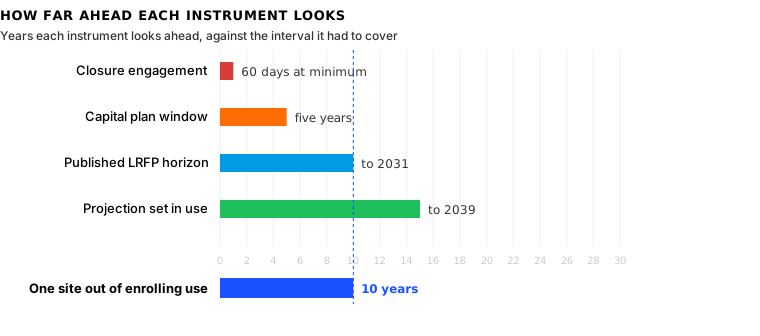
The published Long-Range Facilities Plan states its horizon as a ten-year planning horizon to 2031, with some district projections carried to 20369. The projection set used in the 2025 closure cycle runs to 20396. The engagement that precedes a closure decision runs 60 days at minimum1. A site can be out of enrolling use for longer than three of those four instruments look ahead.
The strategy that has not been written.
The district’s Long Term Planning page describes a document in the conditional future tense. When the results of Land Asset Management Studies identify opportunities to generate new revenues through the lease or disposition of surplus land holdings, the District “will develop” a Land Asset Strategy10.
No such document is linked, named, versioned or dated on that page, and two indexed addresses for it return a 40410.
That is worth stating precisely, because a land asset strategy is the instrument that would otherwise occupy the space between the two policies. It would be the thing that says what a site is for while nobody is deciding what to do with it. Its absence is the space itself.
The record keeps what instruments produce.
Everything in the table above is dated because each date is attached to something an instrument produced. A closure approval. A surplus declaration. A motion to suspend a subdivision. The record is good at those, and the district publishes them.
What no instrument produces, the record does not carry. There is no document that says what the Queen Elizabeth Annex site is for in the interval, because no step in either policy calls for one. There is no document that says what Sir Guy Carleton is for either, and Policy 20 has not begun to run on it. The silence is a faithful reflection of the architecture rather than a failure of publication.
Nothing here argues that any school should have stayed open, or that any site should be sold, leased or held. Boards close schools for documented reasons and those reasons are published in full. Policy 14 does what it says. Policy 20 does what it says. What the record lacks is a rule joining them, and that absence belongs to the architecture rather than to anyone administering it. It is also one district’s policy set, read at one date.
What the holding money would otherwise have bought.
Money spent holding a closed building is money that was also, in each of those years, a maintenance project elsewhere in the estate, a resource room, a childcare retrofit, or a position. At about $65,000 a year the amount is modest, which is part of why it never competes for attention with anything. It accumulates instead, and it surfaces once, in the report that closes the file, where it reads as an argument for closing.
The second cost is a record with no answer in it. A family, a community organisation or a francophone authority reading the file finds a closed school, a surplus declaration in one case and none in the other, and no date on which anything further will be said. Three years and five months of that record at Queen Elizabeth Annex is three years and five months in which the question was live and unanswerable from the page5.
Neither cost is anyone’s fault, and both are the direct product of two policies that each stop where they were written to stop.
One line in Policy 14.
On the day a School Closure Bylaw is adopted, the Board sets a date by which the site’s future use will be reported back in public, and that report carries the running holding cost since enrolling use ended. Not a decision about the site, and no commitment to dispose of it or to keep it. A date, and a number beside it.
A reporting date and a running figure would leave every judgment exactly where it sits now, with the people elected to make it, and would let them make it while the interval is still running rather than after it has closed.
So my conclusion is that the gap between the two policies belongs to neither of them. Each does what it says. Nothing says what happens in between, and a building can sit in that space for a decade without any instrument being breached. That is a designed silence, even if nobody designed it.
If you sit on a body holding a building that stopped being used years ago, ask for the date the next report is due and the figure carried since the last one. Both answers exist. Neither is printed.
Sources
-
Vancouver School Board, Policy 14, School Closure, adopted 24 September 2018, revised 27 May 2026. The definition of closure as more than twelve months, the full closure sequence, the minimum 60-day engagement period, the 14-day notice and submission requirements, the School Closure Bylaw as the decision instrument, and the requirement to notify the Minister without delay. ↩ ↩2
-
Vancouver School Board, Policy 20, Disposal of Land or Improvements, adopted 24 September 2018, amended 27 September 2021. The six disposal steps, the position of the Board resolution declaring a property surplus within that sequence, the consultation requirements, and the Real Property Disposal By-law. ↩
-
Stated minimum periods: three in the closure policy, none in the disposal policy.
Policy 14: 60 days, 14 days, 14 days = 3 stated minima. Policy 20: 0Counted from the two policy texts as recorded. Policy 14 sets a minimum engagement period, a minimum notice period for the public meeting, and a deadline for written submissions ahead of the decision. The six steps of Policy 20 as recorded carry no minimum or maximum period. If either policy carries a period not reproduced in the records read, the count changes. ↩ -
Vancouver School Board, board and committee records for Queen Elizabeth Annex, Sir Guy Carleton and Graham Bruce, 2022 to 2026, assembled from the published agendas and minutes and retrievable through the district’s agendas and minutes search. The closure approval of 6 June 2022 effective 30 June 2023 and the surplus declaration of 11 April 2023 at Queen Elizabeth Annex, the closure of Sir Guy Carleton on 18 December 2025 and the January 2024 acquisition request, and the Graham Bruce consultation of 29 May and 7 June 2023 with the subdivision suspended on 25 September 2023. ↩
-
Months since the Queen Elizabeth Annex surplus declaration with no instrument executed: forty-one.
April 2023 to September 2026 = 41 monthsCounted from the surplus declaration of 11 April 2023 to the publication date of this piece. It measures elapsed time, and it establishes nothing about whether any step was due in that period, because no published instrument sets one. ↩ ↩2 -
Vancouver School Board, Proposed Closure of Sir Guy Carleton Elementary School, report of the Superintendent, Special Board Meeting Agenda (Revised), 17 December 2025. The maintenance figure of roughly $65,000 per year or $650,000 to date, the first published list of what the money covers, the description of the buildings’ condition, and the projection set running to 2039. ↩ ↩2 ↩3 ↩4
-
VTCo, Two published prices, one standing building, Primary Sources, 9 September 2026. The two published figures on the same site, the holding cost and the repair estimate, the 874 days between their publication dates, and the arithmetic between them, with each figure traced to its primary record. ↩
-
Vancouver School Board, Rationale for Closure. The second published list of what the holding cost covers: maintenance, security, inspections, groundskeeping and utilities. ↩ ↩2
-
Vancouver School Board, 2020 Long-Range Facilities Plan, District Overview, 2021 Update, May 2022. The published ten-year planning horizon to 2031, the note that some district projections run to 2036, and the status of the 2020 plan as the current one. ↩
-
Vancouver School Board, Long Term Planning page. The conditional future tense describing a Land Asset Strategy the District will develop, the absence of any linked, named, versioned or dated document, and the two indexed addresses that return a 404. ↩ ↩2