The Split Record A personal column by Vik Khanna, published Mondays.
The price that never had to be argued
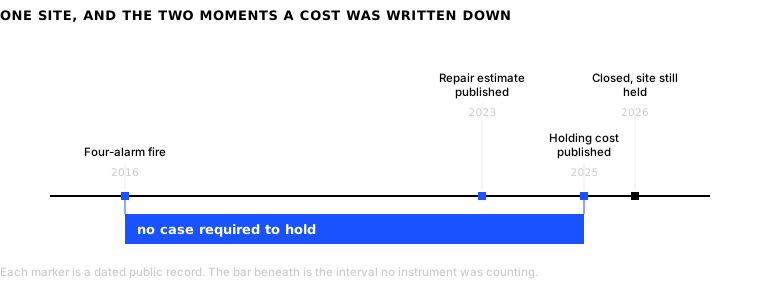
Repairing a fire-damaged school was priced at $8 million to $10 million in June 2023. The cost of holding the same buildings empty first appears in the 2025 cycle, at $65,000 a year. One figure had to be argued for.
Two figures sit in the Vancouver School Board’s record for one address on Kingsway. They were produced two and a half years apart, by different bodies, for different purposes. No page in either document prints them beside each other.
The first is a repair estimate. On 7 June 2023 the Facilities Planning Committee received a report on the consideration of closure of Sir Guy Carleton Elementary. It put the cost of repairing the fire damage and the vandalism damage that followed it at $8 million to $10 million1.
The second is a holding cost. The report that carried the closure to the Board on 17 December 2025 states maintenance on the vacant buildings at roughly $65,000 per year, or $650,000 to date2. The same pair had appeared six weeks earlier, in the information session slides of 28 October 20253.
What I notice about that pair is the distance each one had to travel before it existed. The repair figure was produced because somebody had to decide whether to spend it, and a decision to spend requires a case. The holding figure was produced because the file was closing. Nobody ever had to approve $65,000 a year. It was the arithmetic consequence of approving nothing.
The 2023 report priced one side of the choice.
The 7 June 2023 report carries no holding-cost figure. The $65,000 and $650,000 pair first appears in the 2025 cycle123.
So a reader working from the 2023 record could see what repairing the buildings was estimated to cost. That same reader could not see what leaving them standing and empty was costing, because no document produced that number until the file was being closed.
This matters more than it sounds: a body weighing a repair against continuing to hold is weighing two running totals. In June 2023 the record handed that body one of them.
What a business case is built to do.
A business case is a good instrument and it does what it was built to do. It forces a proposal to state its costs, its benefits and its alternatives, and it gives approvers a document they can compare against other documents. Nothing here argues against the form.
The design point is that a business case is triggered by a proposed action. Somebody proposes to spend, to build, to sell, to close, and the form makes them show the arithmetic before anyone signs.
Nothing triggers the form for the absence of an action. There is no template for continuing, and a body facing a repair estimate of $8 million to $10 million and a holding cost of $65,000 a year is handed a rigorous document for the first and no document at all for the second, and the second runs on either way.
The arithmetic the district’s own two figures support.
The published total divided by the published annual rate gives ten4. Read against the district’s own pair, $650,000 at roughly $65,000 a year is consistent with about a decade of carrying at the stated average.
That division reads no ledger. It checks two published figures against each other and finds them internally consistent, and that is the whole of what it establishes. A year-by-year series has not been published, so the shape of the spending inside those years is unknown4.
The buildings stopped enrolling students in 2016, after a four-alarm fire in the main building in August of that year5. Third reading of the closure by-law came on 18 December 2025, on a vote of five to three6. That interval runs nine years and four months7.
Set the two published amounts against each other and the repair estimate runs from 12.3 to 15.4 times the holding total to date8. About a decade of holding the site cost something between a twelfth and a sixteenth of what repairing it was estimated to cost in 2023.
And the interval between the two reports carries its own figure. From 7 June 2023 to 17 December 2025 is two years and 193 days. At the stated annual rate, that stretch alone accounts for roughly $164,0009, accumulated while the only priced number in the file was the one for the repair.
What the $65,000 covers, and what has not been published.
The district states what the money is for in two places, and the two lists are not identical. The closure report describes critical repairs that address vandalism, break-ins, servicing required for sprinkler systems, heating and necessary maintenance2. The rationale page describes maintenance, security, inspections, groundskeeping and utilities5.
Neither list names insurance. So insurance should not be read into the figure, and this piece does not read it in.
| Figure | Amount | Where it appears | Date |
|---|---|---|---|
| Repair of fire and vandalism damage | $8 million to $10 million | Facilities Planning Committee, consideration of closure | 7 June 2023 |
| Holding cost, stated annual rate | $65,000 | Information session slide deck | 28 October 2025 |
| Holding cost, stated total to date | $650,000 | Superintendent’s closure report, p. 3 | 17 December 2025 |
| Holding cost in the 2023 report | no figure published | Facilities Planning Committee agenda | 7 June 2023 |
| Year-by-year maintenance series | not published | checked across the 2023 and 2025 cycles | as of 17 August 2026 |
| Split across security, utilities, grounds | not published | checked across the 2023 and 2025 cycles | as of 17 August 2026 |
Two of those rows say the same thing in different words. The number that closed the argument in 2025 was absent from the record in 2023, and the detail underneath it has never been published in either cycle.
This piece takes no view on whether the buildings should have been repaired, and it says nothing about how anyone should have voted. Boards close schools for documented reasons, and this file carries an engagement summary, an information session, a rationale page and three readings, all published365.
It also reads one file in one district. The asymmetry described here would have to be tested against other files before anyone could call it a pattern. What the record supports is narrower and firm: in this file, the cost of acting was priced in a report years before the cost of continuing was priced anywhere.
Why the repair figure was never the district’s to spend.
There is an obvious objection to all of this and it deserves to be met head on. The repair estimate was never a cheque the district could write. Capital of that size comes from the province, and the closure report states that the district “has been denied multiple funding requests to repair and seismically upgrade the school”10. On that account the $8 million to $10 million was not a live option the board declined; it was a price on something the board had already been refused.
Take that as read, because the record supports it. It sharpens the point rather than answering it. If the repair figure was never spendable, then the only number in this file that a board actually controlled was the holding cost. That is the figure that accrued year after year out of the district’s own operating funds, and it is the figure that no report carried until the report that proposed to stop paying it.
So the asymmetry sits between a price the district was refused and a price the district was paying. The second one is the one nobody had to argue for, and it is the one that ran for a decade.
What the holding money was also, every year, something else.
Money that holds an empty site is money that was also, in each of those years, something else. A maintenance project elsewhere in the estate. A retrofit. A position. Nobody weighed those against the vacant buildings, and nobody failed at weighing them either, because the comparison never appeared on a page where a person could make it.
The second cost is subtler and larger. When only one column is priced, the priced column looks like the expensive option. A repair estimate of $8 million to $10 million reads as a large number in a room where the alternative carries no number at all. The alternative was running at $65,000 a year the whole time, and by the district’s own pair of figures it had been running for about a decade4.
That is what an unpriced option does to a comparison. It does not tilt the answer by argument. It removes one side of the scale.
One line, on the form that already exists.
Any report that recommends deferring a decision on a standing asset carries three fields beside the recommendation: the annual holding rate, the running total since the asset went out of use, and the date the clock started. The fields update when the report is refreshed.
That is a template change, not a policy, and it costs nothing to add. It would have put $65,000 a year and a running total in front of the 7 June 2023 committee, beside the $8 million to $10 million, in the same table.
Whether that changes any answer belongs to the people who take the votes, and the record shows they took each step for documented reasons. The record does not decide, rank or allocate anything. It informs, and it coordinates, and the boundary stops there. What it can do is refuse to hand a decision-maker one priced column and one blank one.
My conclusion is that the asymmetry was decisive without anyone deciding it. One side of the choice had to be argued for, costed and refused. The other side accumulated on its own and appeared once, at the end, as a reason to stop. A comparison built that way has an outcome before anybody votes.
If you sit on a body that has been carrying something since before the current term, ask for the annual rate and the running total, and ask for both in the same report as the option you are being asked to price.
Further records read for this piece are set out in Sources.11
Sources
-
Vancouver School Board, Consideration of Closure of Sir Guy Carleton Elementary School, Facilities Planning Committee agenda, 7 June 2023. The estimate of $8 million to $10 million to repair the fire damage and the subsequent vandalism damage, and the absence of any holding-cost figure in the 2023 report. ↩ ↩2
-
Vancouver School Board, Proposed Closure of Sir Guy Carleton Elementary School, report of the Superintendent, Special Board Meeting Agenda (Revised), 17 December 2025. The maintenance figure of roughly $65,000 per year, or $650,000 to date, at page 3, and the description of what that money covers, including critical repairs addressing vandalism, break-ins, sprinkler servicing and heating. ↩ ↩2 ↩3
-
Vancouver School Board, Sir Guy Carleton closure consideration, public information session slide deck, 28 October 2025. That the $65,000 and $650,000 pair was presented to the public in October 2025, six weeks before the closure report, and that the 2025 cycle is where the pair first appears. ↩ ↩2 ↩3
-
Years of carrying implied by the district’s own pair of figures: about ten.
650,000 ÷ 65,000 = 10This checks two published figures against each other and finds them internally consistent. It reads no ledger. The district has not published a year-by-year series, so the distribution of spending across those years is unknown, and the annual figure is described as an approximation in the source. ↩ ↩2 ↩3 -
Vancouver School Board, Rationale for Closure, Sir Guy Carleton Elementary School. The second published description of what the maintenance figure covers, namely maintenance, security, inspections, groundskeeping and utilities, and the account of the 2016 fire and the end of enrolment at the site. ↩ ↩2 ↩3
-
Vancouver School Board, board meeting agenda package of 28 January 2026, carrying the December 2025 minutes. First and second readings on 17 December 2025, third reading on 18 December 2025, and the vote of five to three. ↩ ↩2
-
Interval from the fire to third reading: nine years and four months.
August August 2016 to 18 December 2025 = 9 years, 4 monthsMeasured from the month of the fire, which the district states as August 2016, to the dated third reading. The fire month is published without a day, so the interval is stated in months rather than days. ↩ -
The repair estimate as a multiple of the holding total to date: 12.3 to 15.4.
8,000,000 ÷ 650,000 = 12.3 and 10,000,000 ÷ 650,000 = 15.4The low and high ends of the published repair range, each divided by the published holding total. The two figures were produced two and a half years apart for different purposes, so the ratio compares two estimates and not two audited amounts. ↩ -
Holding cost accumulated between the two reports: roughly $164,000.
7 June 2023 to 17 December 2025 = 2 years, 193 days = 2.53 years; 2.53 × 65,000 = 164,450An illustration, not a ledger reading. The $65,000 is an average rate given at the end of the interval, so applying it to a slice inside that interval assumes an even distribution the record does not establish. It is shown to size the gap between the two reports, not to state a spend. ↩ -
CBC News, School board votes to close Sir Guy Carleton Elementary School in East Vancouver, 17 December 2025. The staff report as quoted in the closure coverage: “To return the school to a safe and usable condition, major capital funding would be required from the provincial government,” and “However, VSB has been denied multiple funding requests to repair and seismically upgrade the school.” ↩
-
Checked, not published. Vancouver School Board, maintenance ledger for the vacant Sir Guy Carleton buildings, year by year and by category [no public URL located]. Looked for and absent from public. The published record carries two aggregate figures only, roughly $65,000 a year and about $650,000 to date. No year-by-year series and no split across security, insurance, utilities, grounds or vandalism appears in the 17 December 2025 agenda package, the 28 October 2025 information session slides, the engagement summary of 10 December 2025, or any Facilities Planning package checked. Insurance is named in neither published category list, so it cannot be assumed to sit inside the figure. ↩