The Split Record A personal column by Vik Khanna, published Mondays.
The rent was set in a courtroom
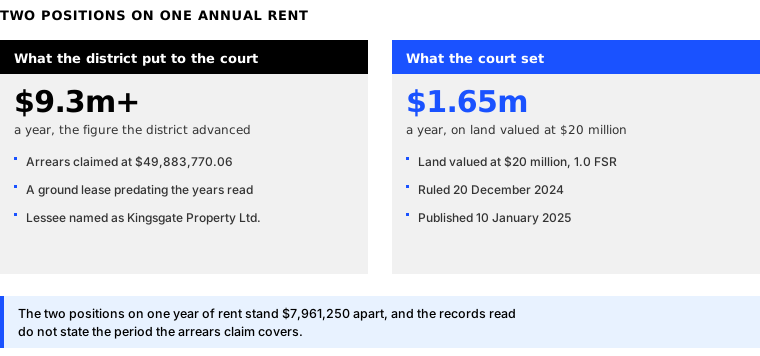
A Vancouver school board and its lessee could not agree what one ground lease was worth. A court settled it on 20 December 2024, at $1.65 million a year against a claim of $9,611,250 or more.
Every instrument on public land contains a mechanism for producing a number at some future date. A lease says what rent is payable and how it changes. A sale says what was paid. A licence says what the use costs. The mechanism is the part nobody reads at signing, because at signing the number is already known.
Decades later the mechanism is the only part that matters, and by then the people who wrote it have gone. What follows is a case where the mechanism did not produce a number the two parties could agree on, so a court produced one instead.
What the court decided.
Kingsgate Mall stands on school board land. On 20 December 2024 the Supreme Court of British Columbia ruled on the rent payable under the ground lease, and the reasons were published on 10 January 20251.
The court set the land value at $20 million at a floor space ratio of 1.0, and set the rent at $1.65 million a year. The district had claimed $9,611,250 or more. Separately, the district had claimed $49,883,770.06 in arrears. The lessee is Kingsgate Property Ltd.1
| Item | Figure | Where it comes from |
|---|---|---|
| Annual rent claimed by the district | $9,611,250 or more | 2022 award, recited at 2026 BCCA 98 |
| Annual rent set by the court | $1.65 million | Reasons for judgment, 20 December 2024 |
| Land value set by the court | $20 million at 1.0 FSR | Reasons for judgment, 20 December 2024 |
| Arrears claimed by the district | $49,883,770.06 | Notice of default of 17 May 2023, recited at 2026 BCCA 98 |
| Lessee | Kingsgate Property Ltd.; originally Royal Oak Holdings Ltd. | Reasons for judgment, 20 December 2024 |
| Original lease date and term | 20 November 1972; ninety-nine years as an initial twenty-five year term with ten-year renewal options, the last for four years | 2024 BCSC 2325, paras 3 to 4 |
The distance between the two positions.
The rent the court set is at most 17.2 per cent of the figure the district advanced23. Put the other way, the two positions on a single year of rent stood $7,961,250 apart4.
That is a wide gap on a quantity both parties were reading from the same instrument, and it tells you something about the instrument without anyone needing to see it. Two well-advised parties, looking at the same words, arrived at answers a factor of five and a half apart2. Language that admits that spread is language whose mechanism had stopped producing an agreed number.
What the ruling implies as a rate on land.
Set the rent against the land value the court worked from and the quotient is 85.25 per cent6.
I want to be careful with that figure. The records read do not say the court applied a rate, and a rate recovered by dividing one published number by another is arithmetic rather than a finding about method. What it does give a reader is a way to hold the ruling in mind. A rent of $1.65 million on land the court valued at $20 million is a return in that region, and anyone who wants to test the ruling against comparable ground leases now has a figure to test with.
The arrears claim, measured against the rent the court set.
The district claimed $49,883,770.06 in arrears. At the rent the court set, that is about 30 years of rent7.
The limits on that division are serious and worth printing. The records read do not state the period the arrears claim covers, and they do not state the date from which the court-set rent runs. The two figures may not describe the same years at all. What the quotient establishes is scale, and scale alone. It says that the amount in dispute was of the order of decades of the rent eventually set, rather than of a year or two.
What the record does not carry.
The instrument itself. Its date, its term, and the machinery inside it for setting rent are not established in the records read, and they stand below as an open gate. The ledger describes the lease as predating the ten years of board decisions this series has been counting, which places it outside that window and says nothing more precise8.
I am not going to fill that in from commentary. A date on a lease is the kind of fact that circulates confidently and turns out, when the instrument is finally read, to be the date of an amendment or an assignment rather than the original grant. Until the instrument is read, the piece runs on the ruling.
Why the missing dates matter more than the missing decade.
The year the lease was signed is a matter of interest. The dates that carry consequences are the next rent review and the expiry, and neither is in the records read.
Those two dates are what a planning document would need. A term end tells a board when land returns to it and therefore when it can be planned for. A review date tells a board when the number changes and therefore when to prepare. Without them, a lease of this kind sits outside every planning horizon the district publishes, because a horizon is built from dates and this one has none a reader can see.
Ministerial Order M193/08 has required Minister approval for a lease of ten years or more since 3 September 20089. This lease predates that order, so the order did not govern its making, and the modern control on long leases arrived long after the longest ones were already running.
This piece takes no position on the ruling, on either party’s conduct, or on what the rent ought to be. A court heard the arguments and set a number, which is what courts are for. Nobody here is characterised, and the lessee is named because the record names it.
It also reads one lease through one judgment. Whether other ground leases on public land in this province carry the same problem is a question the record read does not answer.
A method with one reader at a time.
When the method for producing a number lives inside a single old instrument and nowhere else, the method has one reader at a time and no public version. Between reviews there is no page anyone can consult to learn what the land earns, and no way to see the next review coming.
The cost of that is paid in two places. It is paid in the file itself, where a disagreement over one year of rent stood $7,961,250 apart and had to be resolved by litigation rather than by calculation. And it is paid in every planning document that would otherwise have carried the land, because a document cannot carry a revenue line or a reversion date it has no way to compute.
Neither cost implies that anyone drafted badly when this lease was made. A mechanism is written for the city of its day, by people who cannot know what will be built around it. The failure is architectural: nothing in the system required the mechanism to be restated in public terms as the ground around it changed.
A ground lease register.
One row per lease on district land, five fields: the commencement date, the term, the next rent review date, the method by which rent is set, and the rent now payable. Published and updated when a review concludes.
Five fields would not have prevented this disagreement, and I want to be honest about that. Parties can disagree about valuation with the method fully in view. What five fields would have done is make the disagreement visible years earlier, to a board, to a lessee and to anyone reading the estate, at the point where a negotiated answer was still available.
What I take from it is uncomfortable and I think correct. The most consequential number attached to a Vancouver school site in the last decade was set by a judge, from a 1972 instrument, after two arbitrations and two appeals. No board meeting produced it. No policy governs it. It simply arrived.
In this file the deciding has already been done, by the only body entitled to do it, and no register takes that back. What a register would change is how much anyone else could see before the deciding started.
Further records read for this piece are set out in Sources.101112
Sources
-
Supreme Court of British Columbia, Kingsgate Property Ltd. v Vancouver School District No. 39, 2024 BCSC 2325, 20 December 2024. The land value set at $20 million at a floor space ratio of 1.0, the rent set at $1.65 million a year, the district’s claim of $9,611,250 or more, the district’s claim of $49,883,770.06 in arrears, and the lessee named as Kingsgate Property Ltd. ↩ ↩2
-
The rent set against the rent claimed: 17.2 per cent.
1,650,000 ÷ 9,611,250 = 0.1717, rounded to 17.2 per centThe district’s claim is recorded as $9,611,250 or more, so this quotient is an upper bound. If the claim was higher than $9,611,250 the share is smaller. Expressed the other way, the claim was about 5.6 times the rent the court set. ↩ ↩2 -
Court of Appeal for British Columbia, Vancouver School District No. 39 v. Kingsgate Property Ltd., 2026 BCCA 98, 10 March 2026, both appeals dismissed. That the rent set at trial stands. The Court of Appeal upheld the chambers judge on the 1.0 FSR valuation of $20,000,000 and the resulting annual rent of $1,650,000, and dismissed both appeals. ↩
-
The gap between the two positions on one year of rent: $7,961,250.
9,611,250 - 1,650,000 = 7,961,250A subtraction of two published annual figures. It measures the distance between the positions and establishes nothing about which figure was better supported, which was the matter before the court. ↩ -
Cited, not read at origin. The Kingsgate ground lease of 20 November 1972, the board as lessor and Royal Oak Holdings as lessee, with the 2005 assignment and the rent-review record carried through the courts [no public URL located]. The instrument and its machinery: a ninety-nine year structure built as an initial twenty-five year term followed by ten-year renewal options, the last of them for four years, with basic rent originally set at 8.25 per cent of agreed market value plus a percentage of gross rental income. The rent-setting machinery is what the later arbitrations and appeals turn on. Closed on the Chief Executive research pass of 17 August 2026; the citation is recorded here and the judgment itself has not been read at origin by us. ↩
-
The rent set against the land value the court worked from: 8.25 per cent.
1.65 ÷ 20 = 0.0825The lease sets basic rent at 8¼ per cent of agreed market value, so this is the lease formula reproducing itself rather than a rate the court chose. ↩ -
The arrears asserted, expressed in years of the rent the court set: about thirty.
49,883,770.06 ÷ 1,650,000 = 30.2The arrears figure is the exact amount asserted in the district’s notice of default of 17 May 2023, rent plus GST, recited at 2026 BCCA 98 para 25. It accrued under the 2022 award that was later set aside. The quotient indicates scale and nothing else: the records do not state the period the claim covers. ↩ -
Vancouver School Board, board and committee records for school land transactions, 2016 to 2026, assembled from the published agendas and minutes and retrievable through the district’s agendas and minutes search. That the Kingsgate Mall ground lease predates the ten years of board decisions counted in this series and that no board action on it falls inside that window, and that no consolidated register of district leases was located. ↩
-
Ministerial Order M193/08, Disposal of Land or Improvements Order, effective 3 September 2008. The requirement of Minister approval for a lease of ten years or more, and the effective date of 3 September 2008, which postdates the making of this lease. ↩
-
Vancouver School Board, Policy 20, Disposal of Land or Improvements, adopted 24 September 2018, amended 27 September 2021. The modern disposal sequence, including the title search confirming fee simple and any charges, and the recorded Board commitments of 2015 and 2021 on preserving neighbourhood school sites and declining disposals that decrease public asset value. ↩
-
Ministry of Education and Child Care, school building closure and disposal policy page. The statutory framework the Ministry cites for disposal and leasing of school property, and the statement that only in exceptional circumstances should a board consider permanently disposing of school property. ↩
-
Vancouver School Board, Long Term Planning page. That the district describes a Land Asset Strategy in the future tense, with no such document linked, named, versioned or dated, so no published document sets out the leases on district land or their review dates. ↩