The Split Record A personal column by Vik Khanna, published Mondays.
The inventory that was spent
A district’s spare buildings are its ability to absorb change. Spent one at a time, for good reasons each time, they stop being an inventory and become a set of decisions nobody made together.
I spent several years at a delegation podium. Three minutes, a numbered agenda item, a row of trustees who had read the package. I was there for one file at a time, as everyone in that room always is, and that is the part I want to write about.
A delegation microphone is designed for a single item. So is a board agenda. So is a staff report. Each is a well-made instrument for considering one thing carefully, and the whole system is built out of them.
The consequence is that a district can make a run of sound decisions and end up somewhere nobody chose.
The dysfunction: a portfolio decided one item at a time is not a portfolio decision.
A school district holds land: some of it is in enrolling use, some is leased, some sits between uses. The part that sits between uses is not waste. It is the district’s ability to absorb change: a growth surge, a seismic replacement that needs swing space, a programme that outgrows its building, a neighbourhood that fills faster than the forecast said.
That capacity only exists while the sites do. And sites leave the inventory one at a time.
Every departure has a documented reason attached, and the reasons are usually good ones. A building fails a seismic assessment. A lease pays for a roof somewhere else. A site is surplus to a catchment that has genuinely shrunk. Read individually, each decision holds up.
What no single agenda item asks is what the sixth one does that the first one did not. The instruments are built to evaluate the item. Nothing in them is built to evaluate the running total.
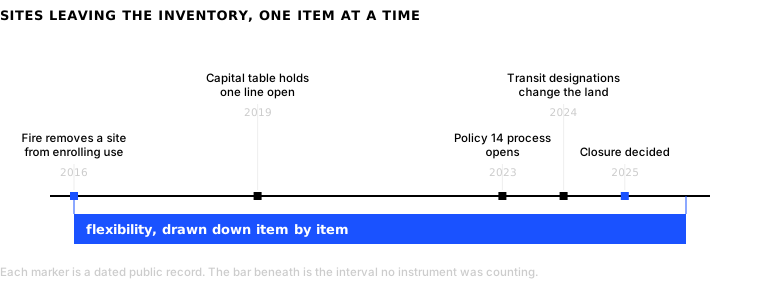
What the district itself already recognised.
This is not a gap the district is unaware of, and the district has an instrument for it. Vancouver School Board publishes a land asset strategy1. What that document says, how often it is refreshed, and whether it requires a portfolio position to be stated on an individual site item are all open here: the strategy has not been read at origin for this piece, so nothing below characterises its contents23.
The tension this piece describes does not depend on what that strategy says. A strategy, whatever its contents, sits in one document. Decisions arrive in a stream of separate items, each with its own deadline, its own report, and its own vote. A strategy is consulted. An agenda item has to be answered by Tuesday.
When a document that thinks in portfolios meets a process that moves in items, the process wins on timing every time. Not because anyone prefers it. Because Tuesday comes.
The trade-off nobody was handed.
Here is what the item-by-item structure does to a decision.
Suppose a district is considering releasing a site. The report in front of the board prices that site: what it costs to hold, what it might yield, what the catchment looks like. That report is accurate and complete for the question it was asked.
The question it was not asked is what the district’s remaining flexibility is worth, and what it costs to have less of it. That figure has no owner. It is not in the site report, because the site report is about the site. It is not in the capital plan, because the capital plan is about projects. It is not in the enrolment forecast, because the forecast is about children.
So the board weighs a real number against a blank. And a real number beats a blank, every time, for entirely rational reasons.
A district one bridge away has since priced that blank. Richmond let a school site go in a 1990 land swap at a valuation of $5.67 million, and bought the same site back in 2025 for $60 million to reopen it as a public school4. Wednesday’s piece sets out that record and its arithmetic in full. What matters here is that the 1990 report was almost certainly correct about 1990. The cost did not come from a bad decision. It came from a decision made without the column that would only exist thirty-five years later.
Why this is hard rather than negligent.
I want to be careful here, because it would be easy to read the above as an accusation and it is not one.
Nobody in a district office is failing to think about the portfolio. The trustees I delegated to asked portfolio questions regularly, and the staff answering them were the same people who wrote the strategy. The parent advisory volunteers who show up for these processes carry more institutional memory than most of the paid roles around them.
The problem is structural and it is genuinely hard. A portfolio value is a counterfactual: what a district would have been able to do, in a future that has not happened, if it still held something it no longer holds. Counterfactuals do not have invoices. They are difficult to put in a report, and a figure that is difficult to produce loses to a figure that is easy to produce, regardless of which one matters more.
The scope of this reading.
This is not a claim that any specific site should have been retained, and it is not a criticism of any board, any staff report, or anyone who voted. Each decision in a sequence like this can be right on its own terms. It is one reading of how single-item instruments behave when they are asked to hold a portfolio question, and one district is not a pattern. The Wednesday piece tests it against another.
What would put this on a page.
A running count, printed on every land item. Not an analysis, not a new strategy document: a standing line at the top of any report proposing a change to a site, stating how many sites have left the inventory in the last ten years and what remains.
A board reading the next land item would see that item and also the ones before it, on the same page, without anyone having to remember. The strategy already knows the number. The agenda item just does not carry it.
If you sit on a body that decides about assets one at a time, ask for the running total to be printed on every report. It is one line, it is already known, and it changes what the room is looking at.
Further records read for this piece are set out in Sources.56
Sources
-
Open gate: the schedule has not been read at origin. Vancouver School Board, land asset strategy [no public URL located]. That the district maintains a strategy addressing its land portfolio as a portfolio. ↩
-
Open gate: the strategy behind this page has not been opened. Vancouver School Board, Long Term Planning, the page from which the land asset strategy is reached. Where the strategy is published. The page was reached; the strategy itself was not read for this piece, which is why the gate above stays open rather than printing as a finding of absence. ↩
-
Open gate: the district-wide count has not been assembled. Vancouver School Board, board and committee decision record, 2016 to 2026, retrievable through the district’s agendas and minutes search. The count and dates of every site that has left the enrolling inventory over the period. The figure in this piece is the dated sequence at one site, not that count, and the piece makes no district-wide numerical claim until this is assembled. ↩
-
Richmond News, 1960s public school bought back by Richmond School District. Harry Eburne Elementary: opened 1962, closed 1982, disposed of in a 1990 land swap at a valuation of $5.67 million, repurchased in 2025 for $60 million with $54 million from the district and $6 million from the province, reopening targeted by the district as early as September 2026. ↩
-
Vancouver School Board, Policy 14 and Policy 20. The single-item processes through which a site change reaches a board decision. ↩
-
City of Vancouver, Transit-Oriented Areas Designation By-law 14090, June 2024. The change in what may be built around designated sites, which occurred inside the interval shown in the figure. ↩