Primary Sources The documents themselves, cited. Published Wednesdays.
One school, three capacity numbers, one page
Renfrew Elementary appears in the district’s capital plan with three capacity figures and one enrolment. Every one of them is correct. Which capacity governs a $51.8 million request is nowhere stated.
A district asking the province to rebuild a school has to say how big the school is. The request for Renfrew Elementary runs to $51.8 million, and the report that makes it answers the question three times.
The four figures.
The district’s capital plan lists Renfrew Elementary among its Year 1 seismic mitigation requests. In doing so it gives the school a nominal capacity of 760, an operating capacity of 619, an enrolment of 475 in 2025-26, and approximately 144 seats of additional capacity available12.
| Figure | Value | What it measures | Where it appears |
|---|---|---|---|
| Nominal capacity | 760 | The building as designed | Year 1 priority table |
| Operating capacity | 619 | The building as programmed | Narrative |
| Enrolment, 2025-26 | 475 | Children actually attending | Narrative |
| Seats available | approximately 144 | Operating capacity less enrolment 3 | Narrative |
All four come from the same report, and the subtraction is exact: 619 less 475 is 1443.
A reader who takes the first number has a school with 285 empty seats4. A reader who takes the second has a school with 144. A reader who takes the third has a school with 475 children in it and no view on capacity at all.
All three readers are quoting the district correctly.
What the 144 is, and what it is not.
The 144 is operating capacity minus enrolment: seats available under the current programming of the building. It is not the spread between capacity definitions. That spread is 1415, the distance from nominal 760 to operating 619, and it measures how much enrolling space current programming subtracts from the design figure through resource rooms, childcare and specialised uses.
The two numbers are three seats apart by coincidence, and conflating them reverses an argument. One says the school has room. The other says the building is programmed well below its design.
The number moved, and not because anything was revised.
The previous submission, dated 16 June 2025, gave the same school an operating capacity of 619 and an enrolment of 462, and stated about 160 seats available6. The figure did not move because a measurement changed. It moved because thirteen more children enrolled7, and the earlier report rounded 157 to about 1608.
Which is the correct behaviour for the figure, and the wrong behaviour for a figure that gets quoted without its year.
Where the school actually sits in the queue.
Renfrew is one of five schools on the Board’s Year 1 seismic mitigation request list, all rated H1, the highest risk category. The published order is King George Secondary first, then Mackenzie Elementary, Killarney Secondary, Renfrew fourth, and David Thompson Secondary fifth1.
The Ministry’s letter of 25 March 2025 advanced no major capital project from capital plan status to project definition report status. The letter of 27 March 2026 did the same9.
So the capacity question carries money. A school with 285 spare seats and a school with 144 spare seats are different arguments in a funding queue, and the district’s own document supports either. Nothing in the plan states which capacity figure governs a surplus determination, an enrolment forecast, or a funding priority. The three coexist, undefined, in one report.
The stakes of a definition.
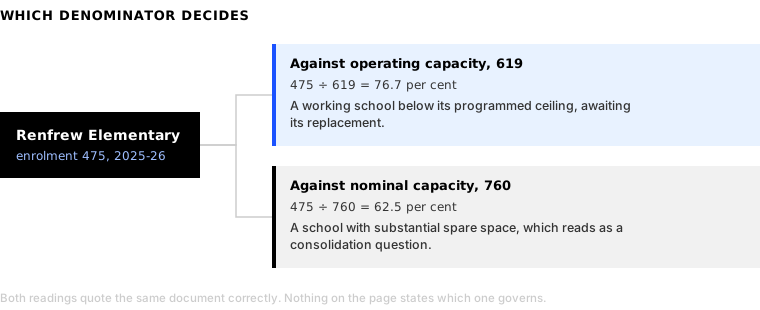
The same plan estimates Renfrew’s full seismic replacement at $51,838,3151. The reading of the school changes with the denominator a decision-maker happens to hold: against operating capacity it runs at 76.7 per cent10 and reads as a working school awaiting its replacement; against nominal capacity it runs at 62.5 per cent11 and reads as a consolidation question.
The document supports both readings, and fifty-one point eight million dollars rides on which one governs. Nothing on the page says which one does.
That is the cost of an unreconciled definition. The trade-off is priced in the tens of millions, and the price never appears beside the choice.
The scope of this finding.
Nominal, operating and enrolled are three legitimate measures, and a plan may reasonably carry all three; the district publishes all four figures openly, which is why a reader can see the problem at all. It argues neither for nor against funding Renfrew, because the record shows a request that has not advanced, and that is all it shows. And it reads one school in one document. The pattern would have to be tested elsewhere before it could be called a pattern.
What would put this on a page.
One sentence in the plan template, stating which capacity figure governs which determination. Nominal for design and replacement scope, operating for utilisation and surplus, enrolment for service delivery, each labelled at the point of use.
That sentence costs nothing to write and settles a fifty-one million dollar ambiguity. Every figure above carries its source, and the record is free to check. Start with the school you know best.
Sources
-
Vancouver School Board, 2027-2028 Five-Year Capital Plan and Minor Capital Plan, Facilities Planning Committee, 17 June 2026. Nominal capacity 760, operating capacity 619, enrolment 475 for 2025-26, approximately 144 seats available, the Year 1 seismic mitigation request list and its published order, the H1 ratings, and the $51,838,315 replacement estimate. ↩ ↩2 ↩3
-
Ministry of Education, Area Standards, May 2012, sections 2.2.1 and 2.2.2, read with the Ministry Long-Range Facilities Plan Guidelines of April 2019. The definitional basis, read at the source. Nominal capacity is a Ministry design constant of twenty pupils per kindergarten classroom and twenty-five per elementary, middle and secondary classroom. Operating capacity is set by adjusting nominal capacity to reflect grade structure and class size, and class size is negotiated in each district’s local collective agreement. The guidelines state the consequence directly: operating capacities vary between school districts. No district-wide conversion factor is published. ↩
-
Seats available, 144.
619 − 475 = 144Operating capacity less enrolment. The plan states approximately 144; the subtraction is exact. ↩ ↩2 -
Empty seats against the design figure, 285.
760 − 475 = 285Nominal capacity less enrolment. This is what a reader gets by taking the first capacity figure in the report. ↩ -
Definitional spread, 141.
760 − 619 = 141Nominal capacity less operating capacity. This is a different quantity from the 144 above and answers a different question. The two are three apart by coincidence. ↩ -
Vancouver School Board, 2026-2027 Five-Year Capital Plan, 16 June 2025. Operating capacity 619, enrolment 462, and the statement of about 160 seats available in the prior submission. ↩
-
Change in enrolment year over year, thirteen children.
475 − 462 = 13The 2025-26 enrolment less the enrolment in the prior submission. This is the entire reason the seats-available figure moved. ↩ -
Seats available in the prior submission, 157 rather than about 160.
619 − 462 = 157The earlier report stated about 160. The exact subtraction is 157, so the prior figure was rounded. Both are the same measure taken a year apart. ↩ -
Ministry of Education and Child Care, capital plan response letters, 25 March 2025 and 27 March 2026 [no public URL located]. That neither letter advanced a major capital project from capital plan status to project definition report status. ↩
-
Utilisation against operating capacity, 76.7 per cent.
475 ÷ 619 = 0.7673, rounded to 76.7 per centRounded to one decimal place. No adjustment is applied for programme type or grade configuration. ↩ -
Utilisation against nominal capacity, 62.5 per cent.
475 ÷ 760 = 0.6250, rounded to 62.5 per centRounded to one decimal place. The gap between this figure and the one above is the whole finding. ↩