Primary Sources The documents themselves, cited. Published Wednesdays.
A site let go, and bought back thirty-five years later
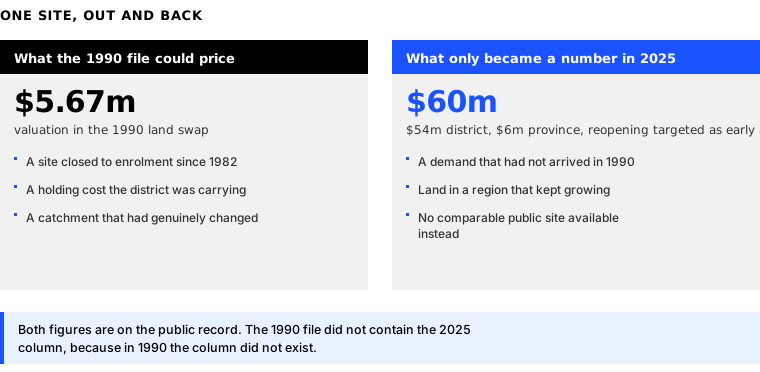
Richmond let a closed school site go in 1990 at a valuation of $5.67 million. In 2025 the same district paid $60 million to buy it back. Both figures are public, and neither file contains the other.
A school district let a closed school go in 1990 and bought the same ground back in 2025. The two prices are $5.67 million and $60 million. Neither file in Richmond mentions the other, and thirty-five years is longer than any planning document either office keeps.
The record.
Harry Eburne Elementary opened in Richmond in 1962 and closed as an enrolling school in 19821. In 1990 the site left the district in a land swap, at a valuation of $5.67 million. In 2025 School District 38 purchased the same site2 for $60 million, $54 million from the district and $6 million from the province, to reopen it as a public school, with an opening target the district states as early as September 20263.
| Entry | What it is |
|---|---|
| 1962 | Opened as a public school. |
| 1982 | Closed as an enrolling school. Twenty years of service. |
| $5.67m | Valuation in the 1990 land swap that removed it from the district. |
| $60m | Paid in 2025 to bring the same site back. |
In nominal dollars that is a multiple of 10.64, across thirty-five years5. Much of it is inflation, and this piece does not attempt the split. The figures are here for a narrower reason: they are what the same public body paid, on the way out and on the way back in, for the same ground.
What the 1990 decision could and could not see.
A district disposing of a closed school in 1990 was answering a specific question: what is this surplus site worth, and what does holding it cost. There is every reason to think the answer was correct. The school had been closed for eight years6, enrolment had moved, and the site was doing nothing.
What the 1990 file could not contain was the 2025 price. Not because anyone failed to forecast it, but because the quantity did not exist yet. The value of holding a site is set by a future demand that has not arrived, and a demand that has not arrived does not have a number.
So the file contained a real figure on one side and nothing at all on the other.
Why this case is here.
The series has so far read one city. One city is not a pattern.
Richmond is a different district, a different council, a different set of officials, and a different decade. The structure that produced the outcome is the same: a decision priced against what was measurable at the time, in a file with no field for the value of retaining an option.
Two districts is not a pattern either. What two districts establish is narrower and harder to dismiss: the missing column is not a quirk of one city’s paperwork.
What this case does not show.
It does not show that the 1990 disposal was wrong. On the information in the 1990 file it may well have been the correct call, and this piece takes no position on it. It does not show that districts should retain every closed site, which would carry its own cost and would be a policy recommendation this series does not make. And the arc that follows tests the structure against instruments rather than against more cases like this one.
Richmond reported the repurchase openly, with its figures, which is the only reason this piece can be written. Buying a site back at ten times what you let it go for is a public body correcting a long-run position at real cost to itself, and saying so in public. That is the record working.
One part of it is not public. The closed-session motion authorising the 2025 purchase does not appear in the district’s published minutes, and it stands as an open gate below.7
What would put this on a page.
A retention column on every disposal report, stating the replacement cost of the option being released rather than the market value of the asset being sold. Not a forecast of future land prices: the cost, at today’s prices, of acquiring an equivalent site if one were needed later.
That figure is computable now, from records districts already hold. In 1990 it would have been a single line, and it would have been the only line in the file speaking for the other side of the trade.
Every figure above carries its source and every calculation is shown. If a district near you has released a public site, the same two columns exist in its records. They are on different pages.
Sources
-
Years in enrolling service before closure, twenty.
1982 − 1962 = 20Opening year to closing year, inclusive of neither endpoint as a partial year. The source gives both years and not the months. ↩ -
School District 38 Richmond, Richmond Board of Education announces new K-7 school in City Centre, 23 June 2025. The board’s own statement of the purchase, its funding split, and the enrolment case for reopening. Until it is read, the figures above rest on the news record alone, which is why the entry above is the only unqualified source in this piece. ↩
-
Richmond News, 1960s public school bought back by Richmond School District. The 1962 opening, the 1982 closure, the 1990 land swap and its $5.67 million valuation, the 2025 purchase at $60 million with $54 million from the district and $6 million from the province, and the planned fall 2026 reopening. ↩
-
The buy-back multiple, 10.6.
60,000,000 ÷ 5,670,000 = 10.58, rounded to 10.6Nominal dollars, thirty-five years apart. No inflation adjustment is applied or implied, and the two figures are not comparable as purchasing power. The 1990 figure is a valuation within a land swap rather than a cash sale price, which is stated in the source and matters to the comparison. ↩ -
Interval between the two decisions, thirty-five years.
2025 − 1990 = 35Measured from the year of the land swap to the year of the repurchase, as the source dates them. ↩ -
Years closed before disposal, eight.
1990 − 1982 = 8From the year the school stopped enrolling students to the year the site left the district. ↩ -
Checked, not published. School District 38 Richmond, the closed-session motion authorising the 2025 purchase [no public URL located]. Looked for and absent from public. Every published 2025 minute set was read and none carries the authorising motion, the price approval, or the allocation of the earlier sale proceeds. The 24 June 2025 special meeting refers to the acquisition as already done, which places the decision in closed session. ↩