The Split Record A personal column by Vik Khanna, published Mondays.
To Be Decided
In 2019 the board put seven projects in a table. Six of them got a decision. The seventh got the words to be decided, and then the province changed the law around it.
I graduated from Sir Guy Carleton Elementary in 1983. For seven years I have been arguing about the wrong document.
I spent those years on enrolment projections. Whose forecast was right, whose model was wrong, what the capture rate should be. It was the argument everyone could see, because the projections were public and the meetings were about them.
The document that mattered was one page long, and I only saw it this year.
Seven lines, and one of them is different
In October and November of 2019 the board kept a table called Capital Commitments. Seven projects. Beside each one, a status. It is a record of a private board meeting, obtained by VTCo and never published by the district, and it is reproduced below in full so you can check my transcription against it.1
| Project line | Status in 2019 |
|---|---|
| Hamber Auditorium | Agreed to (not final) |
| Kitsilano Lawsuit | Estimated |
| Weir 75% Replacement | Agreed to in CPFA (new build) |
| Maple Grove | Agreed to in CPFA (new build) |
| Maple Grove, Rooftop | Agreed to and communicated to community |
| Henry Hudson | Agreed to and communicated to VPO SC |
| Carleton | To be decided |
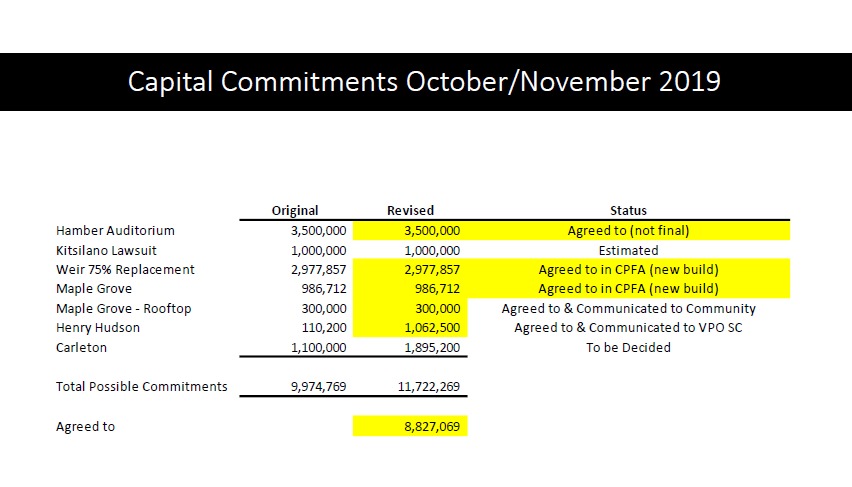
Look at the language. Five lines say agreed to. One is a lawsuit provision, so it says estimated, which is the correct word for money you are holding against something you do not control.
One line says to be decided. It is the school I went to.
Now look at what happened to the others. The board’s own capital plan records what got built. Maple Grove opened in 2020. Weir in 2023. Eric Hamber and Henry Hudson in 2024.2 Every school project that carried the words agreed to in 2019 is finished and open.
On 17 December 2025 the board gave the closure bylaw its first and second readings, 5 to 3. It adopted the third reading the next day.3
Six lines got a decision. One got a placeholder, and the placeholder held for six years until it turned into a closure.
Then the ground moved
In November 2023 the province introduced Bill 47. It requires municipalities to designate transit-oriented areas around rapid transit stations, out to 800 metres, and it prescribes the density and height a municipality must be prepared to allow inside them. Within 200 metres of a SkyTrain station, up to 20 storeys and a floor-area ratio of 5.0. Between 200 and 400 metres, up to 12 storeys. Between 400 and 800, up to 8.4
Vancouver adopted its designation by-law on 26 June 2024, identifying 29 transit-oriented areas, and eliminated minimum parking requirements city-wide the same day.5
Be precise about what that does and does not do, because the city is. The by-law “is not itself a rezoning”. Owners still have to apply.5 So this is not a switch that fills a neighbourhood with towers. It is a change in what the city must be ready to say yes to, across 29 areas at once, in a city that had just removed the parking requirement that used to make the arithmetic fail.
That is not a forecast anyone can be wrong about. It is a change in the ground the forecast stands on.
And the district saw it. Its own closure page says the Policy 14 process, begun by board motion on 26 June 2023, “was paused to assess the impact of provincial housing changes and updated city zoning on student enrolment”.6
Read that sentence again. The board stopped, in writing, to look at exactly this.
The board’s answer, which deserves to be quoted
Here is where I have to be fair to the people I am writing about, because the same page that records the pause also records what happened next.
“In June 2025, updated enrolment projections confirmed that nearby schools can accommodate students both now and in the future.”6 Engagement restarted on 1 October 2025. Staff told trustees that three nearby schools could absorb the catchment for the next fourteen years.7
So the honest answer to did anyone look again is yes. They did. In June 2025, after Bill 47, after the by-law, after the parking repeal.
What they looked at again was the enrolment projection.
That is the distinction this column exists to draw, and it is not a small one. A projection is a forecast about children. The 2019 line was a determination about a building: whether a burned school gets capital, or gets held. Those are different instruments, decided by different people, against different criteria. Updating the first does not reopen the second.
The public record contains a 2025 re-examination of the enrolment case. I have not found a 2025 re-examination of the 2019 capital determination. If one exists, it is not on the closure page, not in the rationale, and not in the pre-engagement materials, and I would genuinely like to be shown it.
What I think happened, and it is not a conspiracy
Nobody hid anything. The 2019 table was internal, but the closure process was public, long, and well attended, with surveys, written submissions and delegation nights.6
What happened is smaller and more ordinary. A determination made in 2019, under 2019 assumptions, about a building that had burned in 2016, became the thing the file rested on. Everything after it was an implementation of it. The pause acknowledged that the ground had moved. The restart carried on from where the pause had begun.
To be decided was never decided. It was carried.
I have spent a lot of my life around decisions like this, in companies rather than boards, and this is the failure mode that costs the most. Not a bad decision. A decision nobody reopened when the reason for it changed.
The question I would ask
Not why did you close it. That question has an answer and the district has given it at length: enrolment, building condition, cost, repeated funding refusals from the province, and a francophone board with a constitutional claim on the site.7
The question is when did you last decide, and about which thing.
Because a capital determination from 2019 and a capital determination from 2025 are different instruments even if they reach the same conclusion. One of them has Bill 47 in it. One of them has 29 designated transit-oriented areas in it. One of them has the city’s own parking repeal in it. The other has none of those, because in 2019 none of them existed.
If you decide again and reach the same answer, the answer is stronger. If you carry the old answer forward, you have not made a decision. You have made a schedule.
What this is not
This is not a claim that the school should have stayed open. I have a view about that and it is not what this column is for.
This is not a claim that the board acted improperly. A board may hold a project line at to be decided, and no rule requires every line in an exercise to resolve in that exercise.
And this is not finished. Three things in the record are unresolved, and they are named here rather than smoothed over.
The vote count was corrected. CBC first reported 6 to 3, then corrected to 5 to 3 the following evening. The headline still carries the old figure. The count in the body, 5 to 3, is the corrected one.7
The two dates are both right, which took reading the minutes to establish. You will see this closure dated 17 December in the press and 18 December by the district, and it is not an error on either side. Three readings of a bylaw at a single meeting require a unanimous vote to proceed that way. On 17 December that procedural motion was defeated, 5 to 3, so the Chair noted that another meeting would have to be scheduled for the third reading. First and second readings carried that evening, 5 to 3. The third reading and adoption followed on 18 December. The school was closed by a bylaw that took two sittings because the board could not agree to do it in one.3
I have not read the schedule. Whether the Carleton site sits inside one of Vancouver’s 29 designated areas is a question the city’s designation by-law answers, and I have not opened it. The argument above does not depend on it, because the district’s own pause was about provincial housing changes generally, not about this site specifically. But I would rather tell you what I have not read than let you assume I have.
What happens next
The building has been closed since December. Whatever happens to the site, the 2019 table does not change, and the status column still reads what it reads.
Ask your board when it last decided something, rather than scheduled it.
Vik Khanna writes The Split Record, his own reading of the public record on Vancouver’s school lands. He is CEO and co-founder of The Visual Thinking Company, which publishes the evidence record separately at thevisualthinkingcompany.com. He graduated from Sir Guy Carleton Elementary in 1983 and spent seven years inside the VSB file, from the Eric Hamber delegations of 2019 through the DPAC executive and its chair. The views in this column are his own.
Sources
-
Capital Commitments October/November 2019 is a record of a private board meeting. It was obtained by VTCo and has not been published by the district. Its companion, Capital Commitments Cashflow, 2017-18 to 2022-23, was obtained with it. Neither appears on vsb.bc.ca. The table is reproduced above in full so that the transcription can be checked against the record. The dollar columns reconcile exactly: the revised total of $11,722,269 minus the Kitsilano estimate of $1,000,000 minus Carleton at $1,895,200 equals the stated agreed-to figure of $8,827,069. ↩
-
Vancouver School Board, 2027-2028 Five-Year Capital Plan and Minor Capital Plan, report dated 3 June 2026, Table 3, SMP Replacement Projects: Maple Grove completed 2020, Weir 2023, Hudson 2024, Hamber Secondary 2024. The Maple Grove rooftop playground is not a line in these tables and is not covered by this sentence. ↩
-
Vancouver School Board, board minutes of the Special Public Board meeting of 17 December 2025, carried in the Board Meeting Agenda package of 28 January 2026. The minutes record the 1,478 submissions received; the defeat of Trustee Mah’s substitution motion to pause the closure pending a renewed business case to the Ministers, 3 for and 5 against; the defeat of the motion to give the bylaw three readings at that meeting, 5 for and 3 against, which failed for want of unanimity; the Chair’s note that a further meeting would be required for the third reading; and the first and second readings carried the same evening, 5 to 3, with Chien, Fraser, Jung, Chan-Pedley and Richardson in favour and Faridkot, Mah and Reddy against. The Secretary Treasurer’s statement that no new details would be released before “the December 18, 2025 Board meeting” fixes the third reading to that date. ↩ ↩2
-
Province of British Columbia, Bill 47 Transit-Oriented Development Areas: Distances, Transit Stations and Densities by Category. For Vancouver at a SkyTrain or Canada Line rapid transit stop, the prescribed minimum allowable density and height are up to 5.0 FAR and 20 storeys within 200 metres, up to 4.0 and 12 storeys from 200 to 400 metres, and up to 3.0 and 8 storeys from 400 to 800 metres. These are minimums on what a municipality must allow, not minimums on what must be built. ↩
-
City of Vancouver, Vancouver passes two significant actions to promote diverse housing and transit-friendly communities, 26 June 2024: Council adopted the Transit-Oriented Areas Designation By-law, designating 29 TOAs, and eliminated minimum parking requirements city-wide for all land uses on the same day. The city’s own qualification is quoted here in full: “The TOA By-law is accompanied with a rezoning policy which provides guidance on rezoning conditions, but is not itself a rezoning. Property owners will need to apply to rezone their property if they would like to increase height and/or density above what is currently allowed.” ↩ ↩2
-
Vancouver School Board, Carleton Elementary School: Closure, page updated 23 July 2026: the board motion of 26 June 2023 beginning consultation under Board Policy 14; the process “paused to assess the impact of provincial housing changes and updated city zoning on student enrolment”; the June 2025 updated enrolment projections; the restart of public engagement on 1 October 2025; the engagement record of surveys, written feedback and delegations; and the statement that “At the December 18, 2025, Special Board meeting, trustees voted for the formal closure of Sir Guy Carleton Elementary School.” ↩ ↩2 ↩3
-
CBC News, School board votes to close Sir Guy Carleton Elementary School in East Vancouver, Akshay Kulkarni, posted 17 December 2025, last updated 19 December 2025: the vote, carried 5 to 3, at “the board meeting on Wednesday”; the defeated motion from trustee Suzie Mah; the school’s opening in 1896 at 3250 Kingsway; the staff report that “VSB has been denied multiple funding requests to repair and seismically upgrade the school”; the projection that three nearby schools can accommodate the area’s students for fourteen years; and the correction, dated 18 December 2025, from a reported 6 to 3 to the actual 5 to 3. ↩ ↩2 ↩3