The Split Record A personal column by Vik Khanna, published Mondays.
Four prices on one site
A Vancouver school board sold the parcel beneath one of its schools, kept the surface, rebuilt the school on it, and priced four separate things along the way.
The Lord Roberts Annex is described, in a good deal of ordinary discussion, as a school site a Vancouver board let go in 2018. I have used something close to that description myself, and the record does not support it.
What the board sold was the subsurface parcel. The surface was retained. A replacement school stands on the site. The site never left the enrolling inventory, and the consideration on the agreements around it ran to $73 million to $75 million1.
That correction is worth more than a footnote, because once the transaction is read accurately it stops being a story about losing a site and becomes a worked example of how much structure a public body can extract while keeping the part that matters to it.
What the Board approved on 25 June 2018.
The Board approved the agreements on 25 June 20182 and they were concluded by September 20181. Four things carry a price.
| Element | Consideration | What it is |
|---|---|---|
| Subsurface parcel | $48.3 million | The ground below the site, sold |
| Statutory rights-of-way and covenants | $16.7 million | Rights registered over the land, and promises attached to it |
| Construction lease | $8.0 million | Use of the site during a five-year construction period |
| Playfield | up to $2.0 million | Works on the surface the board kept |
| Total | $73.0m to $75.0m | Three fixed elements plus one upper limit 3 |
Three of the four are fixed amounts, and the playfield element is an upper limit, which is why the chain is a range rather than a figure3.
The construction lease works out at $1.6 million a year across its five-year term4. That is a price for temporary use of a surface the board never gave up.
Which figure is the consideration.
There are two honest answers, and they sit $24.7 million to $26.7 million apart5.
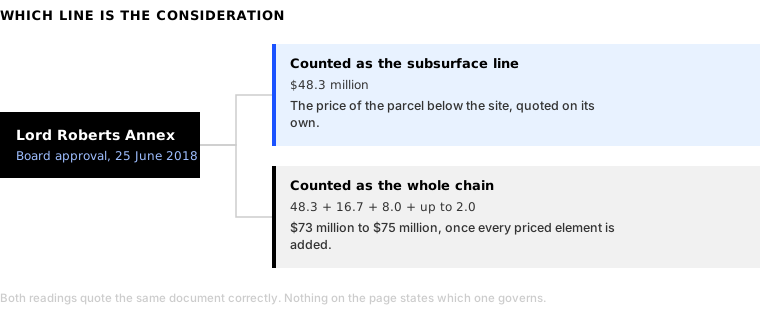
The subsurface line is 64.4 to 66.2 per cent of the chain6. Everything beyond the parcel itself, meaning the rights-of-way, the covenants, the construction lease and the playfield works, is 33.8 to 35.6 per cent5.
A third of the money attached to things that are invisible on a site plan. Rights to run services through ground. Promises about what will and will not happen on it. Temporary use during construction. Works on a surface that never changed hands.
A site is a bundle, and the bundle comes apart.
This is the part I think is generally underweighted, and it is a matter of instrument design rather than anyone’s intention.
Public discussion of school land runs on a binary. A site is kept or a site is sold. Almost every count I have seen, including counts I have built, sorts transactions into those two boxes. The Lord Roberts Annex fits neither, because the board sold one interest in the land, granted several more, retained the one that carries a school, and was paid separately for each7.
Land is a bundle of severable interests, and every interest has a price. That is ordinary property law, familiar to every conveyancer in the province. What is less ordinary is seeing a public body price four of those interests in one transaction and publish the amounts.
The consequence for the record is direct: a count that recognises only sales and retentions has no cell for this transaction, so it goes into the wrong one, and the site appears to have left an inventory it never left.
Why the surface is the part that carries a school.
The enrolling inventory is, in the end, a count of surfaces. A classroom sits on ground. A playfield sits on ground. A catchment is drawn around ground.
A subsurface parcel holds none of those things. It holds structure, services, parking and whatever else engineering allows below grade. Selling it removes value from the estate and removes no seats, provided the surface stays and a school is built back on it. That last clause is doing all the work, and in this case the record shows a replacement school on the site1.
Which means the interesting question about a transaction like this is never how much came in. It is which interest went out and whether the part that carries children stayed. The published record answers both here, and I have not found another Vancouver transaction in the ten years to 2026 with the same shape.
The policy arrived three months later.
Policy 20, Disposal of Land or Improvements, was adopted on 24 September 2018, three months after the Board approved these agreements89. So the policy was not in force on the decision date, and the agreements were not made under it.
That is a timing fact and not a criticism. It is worth stating because of what Policy 20 then went on to require. Its machinery turns on a Board resolution declaring “the property” surplus, and on a Real Property Disposal By-law confirming that the land is not required for future educational purposes9. The records read do not show how that language applies to a subsurface parcel below a school in continuing use, where the land is required for educational purposes on its face and part of it is being sold at the same time.
Ministerial Order M193/08 was in force and had been since 3 September 2008. It provides that a board must not dispose of land by sale and transfer in fee simple, or by lease of ten years or more, unless the disposal is to another board or an independent school for educational purposes or is approved by the Minister10. The Ministry’s own policy page adds that only in exceptional circumstances should a board consider permanently disposing of school property11. What route these agreements took through the order is not in the records read, and it stands below as an open gate.
Pricing requires a valuation and no appraisal is in the records read. It credits no one and blames no one, and it names no counterparty, because the records read do not name one.
It also reads one transaction, and whether a severable structure would suit any other site depends on the site, the market, the engineering and the school on top of it, none of which this piece examines.
Money is the wrong place to look for the cost.
Money is the wrong place to look for the cost. On the published record this transaction brought money in and kept a school on the ground. The cost falls on the record, which has no category for what happened, so the transaction gets filed in the nearest available box and reported as a disposal.
Miscategorisation is expensive in a quiet way. It corrupts every count built on top of it. A board asking how often it has disposed of school land in a decade gets an answer that includes a site with a working school on it. A community reading that count concludes the estate is shrinking faster than it is. A future board weighing a proposal for another site has no clean precedent to reason from, because the one precedent with this structure is filed as something else.
The wider cost is that the option itself stays out of view. If the only two moves anyone can see in the record are hold and sell, the third move goes unconsidered, and the third move is the one that produced $73 million to $75 million here without taking a school off the map.
Three fields on every completed land transaction.
Which estate was transferred. Which estate was retained. Whether the site remained in enrolling use on the day after closing.
Three fields, filled in at the by-law stage, would have made this transaction self-describing. The count would then be correct by construction, because the category would come from the instrument rather than from whoever was compiling the list afterwards. Nothing in that requires a new policy, a review, or a study. The information exists on the day the agreement is signed.
My reading is that the four prices are not the story. The story is that they were never added up in public, and that a transaction which kept the surface, sold what was underneath and rebuilt the school on top is genuinely hard to characterise from the record. A reader cannot say whether it was a good deal. Neither can I.
Three fields would not have changed one word of what the Board decided on 25 June 20182. They would change what every reader since has been able to say about it, which is the whole of what a record is for.
Further records read for this piece are set out in Sources.1213
Sources
-
Vancouver School Board, board records for the Lord Roberts Annex agreements, Board approval 25 June 2018, agreements concluded by September 2018, assembled from the published agendas and minutes and retrievable through the district’s agendas and minutes search. The approval date, the conclusion of the agreements, the four priced elements of $48.3 million for the subsurface parcel, $16.7 million for statutory rights-of-way and covenants, $8.0 million for a five-year construction lease and up to $2.0 million for the playfield, the retention of the surface, and the replacement school standing on the site. ↩ ↩2 ↩3
-
Vancouver School Board, Vancouver School Board approves moving forward with proposal from BC Hydro for underground substation at Lord Roberts Annex property, 27 June 2018. The board approval. The release is datelined Vancouver, 25 June 2018, and records that “At its open board meeting tonight, trustees of the Vancouver School Board approved moving forward with a deal to sell BC Hydro a subsurface parcel beneath the Lord Roberts Annex” site. ↩ ↩2
-
The consideration chain: $73.0 million to $75.0 million.
48.3 + 16.7 + 8.0 = 73.0, and 73.0 + up to 2.0 = 73.0 to 75.0Three elements are fixed amounts and the fourth is stated as an upper limit, so the chain is a range. The arithmetic adds published amounts and makes no adjustment for the timing of any payment. ↩ ↩2 -
The construction lease, spread across its term: $1.6 million a year.
8,000,000 ÷ 5 = 1,600,000A nominal division across the stated five-year term. It applies no discount rate and reflects no view about when the amount was received or how the lease was structured internally. ↩ -
The share of the chain attaching to something other than the parcel: 33.8 to 35.6 per cent.
24.7 ÷ 73.0 = 0.338 and 26.7 ÷ 75.0 = 0.356Rights-of-way and covenants plus the construction lease, then the same with the playfield upper limit added to both sides. It measures how much of the consideration attached to rights, promises, temporary use and works rather than to the parcel sold. ↩ ↩2 -
Open gate: the conveyance has not been published in full. The executed Lord Roberts Annex agreements, the parcel areas transferred, the counterparty, and any Ministry approval under Ministerial Order M193/08 [no public URL located]. Not published in full. The board record carries the amounts and the dates. The structure of the conveyance, the parcel areas, the counterparty, and the approval route under Ministerial Order M193/08 are absent, so this piece names no counterparty and states no area. ↩
-
Interval between the Board approval and the adoption of Policy 20: three months.
25 June 2018 to 24 September 2018 = 3 monthsIt establishes that the policy was not in force on the date of the decision. It says nothing about what internal practice governed the decision at the time, and the records read do not cover that. ↩ -
Vancouver School Board, Policy 20, Disposal of Land or Improvements, adopted 24 September 2018, amended 27 September 2021. The adoption date of 24 September 2018, the requirement of a Board resolution declaring the property surplus, and the Real Property Disposal By-law, which confirms that land is not required for future educational purposes before title moves. ↩ ↩2
-
Ministerial Order M193/08, Disposal of Land or Improvements Order, effective 3 September 2008. The prohibition on disposal by sale and transfer in fee simple, or by lease of ten years or more, without an educational transfer or Minister approval, and the fact that the order was in force in 2018. ↩
-
Ministry of Education and Child Care, school building closure and disposal policy page. The statement that only in exceptional circumstances should a board consider permanently disposing of school property. ↩
-
Vancouver School Board, Long Term Planning page. That the district describes a Land Asset Strategy in the future tense, with no such document linked, named, versioned or dated, so no published strategy sets out how severable interests in school land are to be treated. ↩
-
Vancouver School Board, Vancouver School Board and BC Hydro conclude agreement for underground electrical substation at Lord Roberts Annex site. The four priced elements and the stated total, in the district’s own words: “a minimum of $73 million (up to $75 million): $48.3 million for the subsurface parcel (received in September 2018); $16.7 million for various statutory rights-of-way and covenants (received in September 2018); $8.0 million for a five-year construction lease (payable in 2023 when construction of the substation is planned to begin); and, Up to $2.0 million for the construction of a play field at the Lord Roberts Annex site following completion of the substation construction, anticipated in 2028.” ↩