The Split Record A personal column by Vik Khanna, published Mondays.
A recommendation has no execution date
The Board approved the closure of Queen Elizabeth Annex on 6 June 2022 and declared the site surplus on 11 April 2023, recommending a transfer to the francophone school authority.
Every file I read about a closed public building splits in two at the vote. Before the vote there is a closure record, and it is dense: notices, engagement windows, submissions, readings, a count. After the vote there is a disposal record, and it is a different kind of document. It says what a board would like to happen next.
The closure record is governed by a policy that counts days. The disposal record is governed by a policy that lists steps. That difference reads as procedural. It decides how long a public site sits.
Queen Elizabeth Annex is the shortest illustration of it in the Vancouver record, which is why I keep going back to the file.
The dated half.
The Board approved the closure of Queen Elizabeth Annex on 6 June 2022, effective 30 June 2023. On 11 April 2023 the Board declared the property surplus, with a transfer to the francophone school authority recommended, by sale or by long-term lease1.
The surplus declaration therefore arrived 80 days before the school stopped operating2. That ordering is worth noticing: the status of the land was settled before the last day of the school that stood on it.
| Step | Date | What it settled |
|---|---|---|
| Closure approved | 6 June 2022 | The decision, at a public board meeting |
| Surplus declared | 11 April 2023 | The property’s status, with a recommended route |
| Closure effective | 30 June 2023 | The last day of enrolling operation |
| Instrument executed | None on the record read | Nothing yet |
Three of those four lines carry a date. The fourth is the piece.
The undated half.
As at 17 August 2026, the date this record was read, no instrument has been executed on the site1. That is 1,224 days from the surplus declaration3, three years and four months.
Policy 14, which governs closure, states its intervals in days: at least 60 days of engagement, at least one public meeting with the Board present announced at least 14 days in advance, written submissions public and before the Board no later than 14 days before the decision, and notification of the Minister without delay4.
Policy 20, which governs disposal, sets out six steps, and they run from a title search to the transfer of title: a search confirming fee simple and any Crown grants or charges, consultation on future enrolment growth and alternative community use, a Board resolution declaring the property surplus followed by survey plans and a public request for proposals or tender, an application for Minister approval with appraisals, a disposal by-law confirming the land is no longer required for future educational purposes, and notification of the Minister before title transfers5.
The steps are stated as a sequence. Not one of them is stated as an interval.
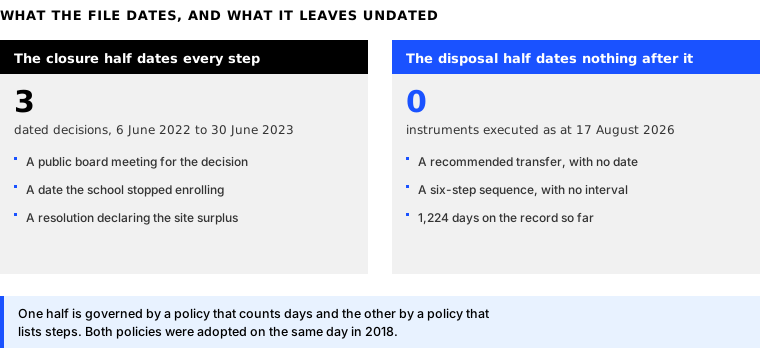
Both policies were adopted on 24 September 2018. Policy 20 was amended on 27 September 2021 and Policy 14 was revised on 27 May 202645. Two instruments, the same author, the same estate, and two different treatments of time.
The route the order exempts.
Above the policies sits Ministerial Order M193/08, effective 3 September 2008. A board must not dispose of land or improvements by sale and transfer in fee simple, or by a lease of ten years or more, unless the disposal is to another board or an independent school for educational purposes, or the Minister approves it6.
So the order names one route through which a long-term disposal proceeds without ministerial approval: a transfer to another board for educational purposes. Whether the transfer recommended at Queen Elizabeth Annex sits inside that exemption is a question an executed instrument would answer, and no instrument has been executed.
The Ministry’s own policy page states the general position: only in exceptional circumstances should a board consider permanently disposing of school property, and property sold for non-educational and non-community use goes to public tender or another competitive process7.
Read together, those two records describe a system that is careful about the terms of a disposal and silent about its timing.
The court, and what this piece leaves open.
A proceeding in the Supreme Court of British Columbia is reported to bear on this file. The decision was not read for this series, so it prints below as an open gate8, and nothing in this piece rests on it.
I want to be exact about what that means. It means the piece describes the board record and the policy framework, and says nothing about what any court has held, required or declared. If the decision changes the reading above, the reading above changes when the record is read, and the gate is printed so a reader knows which sentences would move.
A recommendation costs nothing to leave.
A recommendation costs nothing to make and nothing to leave. That is the property that makes it useful early in a file, and it is the same property that lets a site sit.
No holding figure for this site appears in the record read for this piece. For a different closed site in the same district, Sir Guy Carleton, the published figure is roughly $65,000 a year, covering maintenance, security, inspections, groundskeeping and utilities9. The record read here does not state whether the annex costs more or less than that. What the record does establish is that a standing building consumes something every year, and no page carries the running total for this one.
The second cost falls on the other party. A public authority that has been recommended a transfer cannot plan against a recommendation. It can plan against an instrument, and until one exists it can only wait, holding its own enrolment question open for as long as the file stays quiet.
The third cost is to the reader. A family, a community association or a trustee elected after 2023 opens this file and finds a decision, a status, and then nothing. There is no line that says the matter is progressing, no line that says it has stalled, and no date against which either statement could be tested.
Boards hold sites open for documented reasons, including the reason that a counterparty is still working out what it needs. It reads one file in one district, and a second file would have to show the same shape before the shape could be called a pattern.
A date on the surplus declaration.
The resolution that declares a property surplus already names the property and the recommended route. One clause more would name the date by which an instrument is executed or the declaration returns to the board for a fresh decision.
That clause changes nothing about what any board decides. It changes how long a decision stays unexecuted without anyone being asked about it. A board that wanted more time would take it in public, with a reason and a new date, which is how the closure half of the same file already works.
A date decides nothing. It settles when somebody has to say, in public, that nothing has happened yet.
My own view, since a column owes one: the gap between recommending a transfer and executing one is not a scheduling problem, it is an accountability problem. A recommendation with no execution date cannot be late, and a thing that cannot be late will not be chased. Forty-two months is what that produces.
If you sit on a body that has declared something surplus, ask for two dates: the date it was declared, and the date by which an instrument is expected. Both belong on the same page.
Sources
-
Vancouver School Board, board decision record for Queen Elizabeth Annex: closure approved 6 June 2022 effective 30 June 2023, surplus declared 11 April 2023, with a transfer to the francophone school authority recommended by sale or long-term lease, assembled from the published agendas and minutes and retrievable through the district’s agendas and minutes search. The three dated decisions, the recommended route, and that no instrument had been executed on the site as at 17 August 2026. ↩ ↩2
-
Days between the surplus declaration and the effective date of closure: 80.
11 April 2023 to 30 June 2023 = 80 daysCounted from the day after the declaration to the effective date inclusive of neither endpoint as a partial day. It establishes the order of the two decisions and nothing about why they were taken in that order. ↩ -
Days from the surplus declaration to the date the record was read: 1,224.
11 April 2023 to 17 August 2026 = 1,224 days, or three years and four monthsMeasured to 17 August 2026, the date the board record was read for this series, and not to the publication date. The count states elapsed time only. It carries no claim about what any party was doing during it. ↩ -
Vancouver School Board, Policy 14, School Closure, adopted 24 September 2018, revised 27 May 2026. The stated intervals: at least 60 days of engagement, a public meeting announced at least 14 days in advance, written submissions before the Board no later than 14 days before the decision, and notification of the Minister without delay. ↩ ↩2
-
Vancouver School Board, Policy 20, Disposal of Land or Improvements, adopted 24 September 2018, amended 27 September 2021. The six steps from title search to transfer of title, the surplus resolution, the public request for proposals or tender with its exceptions, the application for Minister approval, and the disposal by-law. ↩ ↩2
-
Province of British Columbia, Ministerial Order M193/08, Disposal of Land or Improvements Order, effective 3 September 2008. The prohibition on sale and transfer in fee simple or a lease of ten years or more without Minister approval, and the exception for disposals to another board or an independent school for educational purposes. ↩
-
Ministry of Education and Child Care, school building closure and disposal policy. That only in exceptional circumstances should a board consider permanently disposing of school property, and that property sold for non-educational and non-community use goes to public tender or another competitive bidding process. ↩
-
Cited, not read at origin. Supreme Court of British Columbia, 2023 BCSC 2123, 1 December 2023, chambers decision dismissing the parents’ petition, read with 2025 BCSC 962 of 23 May 2025. The judicial record on the annex: the petition dismissed in December 2023, and the tenure orders of May 2025. Closed on the Chief Executive research pass of 17 August 2026; the citation is recorded here and the judgment itself has not been read at origin by us. ↩
-
Vancouver School Board, Proposed Closure of Sir Guy Carleton Elementary School, report of the Superintendent, Special Board Meeting Agenda (Revised), 17 December 2025. The published holding figure of roughly $65,000 a year for a different closed site in the same district, and the categories that figure covers. ↩