The Split Record A personal column by Vik Khanna, published Mondays.
The order requires a policy and sets no period
A Ministerial Order in force since 2008 tells every board of education in British Columbia to write a disposal policy and publish it. Vancouver wrote Policy 20.
When a rule tells an organisation to write its own procedure, the interesting part of the rule is what it says that procedure has to contain. That is the part the organisation cannot leave out, and everything else is discretion.
British Columbia has such a rule for school land. It has been in force since 3 September 2008. It tells every board of education to develop a disposal policy and to make it public, and I went looking for what it requires those policies to hold.
It requires them to be consistent with the order and to be publicly available. On the text I read, it requires no period for anything.
What the order requires, and what it hands to the board.
The Disposal of Land or Improvements Order, Ministerial Order M193/08, took effect on 3 September 2008 under sections 96(3) and 168(2)(t) of the School Act1.
Section 3 sets a threshold. A board must not dispose of land or improvements by sale and transfer in fee simple, or by way of a lease of ten years or more, unless the disposal is to another board or an independent school for educational purposes, or the Minister approves it1.
Section 4 opens a lane below that threshold. A board may dispose by way of lease, other than a lease of ten years or more, where the disposition is to an agency or organisation for an alternative community use1.
Section 5 names the approval. The Minister may approve a disposition, with any terms and conditions1.
Section 6 hands the procedure back. Boards must develop and implement policies and procedures with respect to the disposal of land or improvements, consistent with the order, and make these policies and procedures publicly available1.
So the order does three things and delegates a fourth. It names a threshold at ten years. It names an approval. It names a lane underneath. And it tells the board to write the sequence itself, subject to one test, consistency with the order, and one duty, publication.
Read section 6 for what it omits and the shape of the whole file appears. It says the policy must exist. It says the policy must be consistent. It says the policy must be public. On the text I read it says nothing about how long any step in that policy may take.
The two policies Vancouver wrote.
Policy 14, School Closure, was adopted on 24 September 2018 and revised on 27 May 2026. It treats a closure as any cessation of more than twelve months and sets out a sequence with three counted intervals inside it: engagement of at least 60 days, at least one public meeting with the Board present announced at least 14 days in advance, and written submissions before the Board no later than 14 days ahead of the decision. The decision itself is taken by School Closure Bylaw at a public Board meeting, and the Minister is notified without delay2.
Policy 20, Disposal of Land or Improvements, was adopted on the same day and amended on 27 September 2021. Its six steps run from a title search confirming fee simple and any Crown grants or charges, through consultation on future enrolment growth and alternative community use, then, after a Board resolution declaring the property surplus, survey plans and a public request for proposals or tender, an application for Minister approval with appraisals, a Real Property Disposal By-law, notification of the Minister, and transfer of title3.
Primary Sources of 21 September counted the stated minima on each side and found three against none4. The count is settled, and what it leaves open is where in each sequence the checks actually sit, and that turns out to be the part that governs how long a site can wait.
Where each policy puts its check.
| Step | Policy | The check it carries | Period stated |
|---|---|---|---|
| Superintendent recommends at a public meeting | 14 | Publication | None |
| Board initiates engagement by motion | 14 | A vote in public | None |
| Public engagement | 14 | Counted days | At least 60 days |
| Public meeting with the Board present | 14 | Counted notice | At least 14 days |
| Written submissions before the Board | 14 | Counted lead time | No later than 14 days prior |
| School Closure Bylaw | 14 | A vote in public | None |
| Title search | 20 | Administrative | None |
| Consultation on future growth and community use | 20 | Consultation | None |
| Board resolution declaring the property surplus | 20 | A vote in public | None |
| Survey plans and public RFP or tender | 20 | A competitive process, four exceptions | None |
| Application for Minister approval with appraisals | 20 | External approval | None |
| Real Property Disposal By-law and transfer of title | 20 | A vote in public, then registration | None |
Read down the last two columns and the shape appears. Every counted period in this architecture sits in the closure policy, and every one of them sits before the decision. Every external approval sits in the disposal policy, and every one of them sits after the decision to dispose has been taken.
The join between the two sequences carries neither. A closure bylaw ends the first policy. A surplus resolution begins the second. Nothing in either instrument requires the resolution to be moved, and nothing in the order above them requires it either.
That is the finding, and it follows from the delegation rather than from anything the district did. Section 6 asked for a policy. It did not ask for a clock, so the policy that came back does not carry one.
Four routes past the competitive step.
One step in the disposal sequence is different in kind from the rest, and it is worth isolating. The public request for proposals or tender is the only point at which an outside party sets a price in the open.
Policy 20 states four exceptions to it: not-for-profit organisations, public authorities, land exchanges, and consolidation with adjacent land3. Four routes5.
Each of the four is a recognisable public purpose, and the Ministry contemplates the same thing from above: property sold for non-educational and non-community use goes to public tender or another competitive bidding process, which is a sentence that carves out educational and community use by implication6.
What the four share is structural: each removes the step at which the land would have been priced by someone outside the two parties to the transaction. That is a design choice with reasons behind it, and it is also the reason a whole class of school-land instruments never produces a public price.
The Ministry’s own threshold, and what it leaves unsaid.
Above the order and the policies sits a Ministry page carrying one sentence that governs the disposition of school property in this province: only in exceptional circumstances should a board consider permanently disposing of school property6.
That is a threshold in ordinary language, and it is a high one. What it has not got is a test. Nothing on the page states who determines whether a circumstance is exceptional, against what record, at what point in the sequence, or by when.
So the architecture holds a high substantive bar and no procedural clock, and the two facts sit in different documents.
The dates on the instruments themselves.
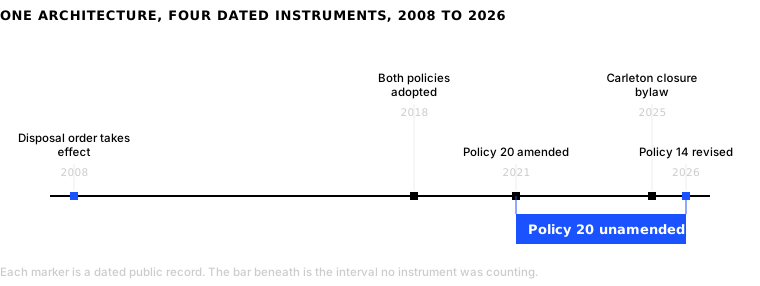
The order has been in force for eighteen years and sixty days7. Both policies were adopted on the same day in 2018. Policy 20 was amended on 27 September 2021 and has stood unchanged for five years and thirty-six days8. Policy 14 was revised on 27 May 2026, four years and eight months after the disposal policy was last touched9.
Both cycles are ordinary policy maintenance and neither is late by any published standard, because no published standard exists. What the dates record is that of the two halves of this architecture, the half with the counted periods has been revised more recently, by four years and eight months.
One policy ran in full; the other never started.
Sir Guy Carleton went through the whole of the first policy. Third reading of the closure bylaw was taken on 18 December 2025, after an engagement process, an information session and a published rationale10. The district put the cost of holding the buildings at roughly $65,000 per year, or $650,000 to date, in the report that recommended closure10.
It has not reached a surplus resolution, so the second policy has not begun to run on it, and nothing in the order, the policy or the Ministry page requires anyone to move it4.
The first cost is the ordinary one. Money that holds an empty building is money that was also, in each of those years, a maintenance project elsewhere in the estate, a resource room, a childcare retrofit or a position. At roughly $65,000 a year the sum never competes for attention. It accumulates instead.
The second cost falls on anyone reading the file. A family, a community organisation or another public authority opens it and finds a completed closure with dates on every step, then a disposal sequence that has not started, with no date on which it is due to. The record is complete and it has no answer in it.
The third cost is the one the delegation created. Section 6 of the order is the single place where a period would apply to every board in the province at once. It is written, it is in force, and it has been in force for eighteen years7 without one.
Nothing here argues that any school should have stayed open, that any site should be sold, leased or held, or that any board acted improperly. Policy 14 does what it says. Policy 20 does what it says. The order does what it says, and section 6 delegates a procedure it was entitled to delegate. It is one province’s order and one district’s policy set, read on one date, and a second district’s policies would have to show the same silence before the silence could be called general.
One clause in section 6 of the order.
Boards must state, in the policy the order already requires them to write and publish, the period within which each step is to be taken or reported back on in public.
That clause decides nothing. It does not require a board to dispose of anything, to hold anything, or to move at any particular speed. A board that wanted longer would take it in public, with a reason and a fresh date, which is how the closure half of the same architecture already works.
A period decides nothing about disposal. It settles only that a board which has taken longer than the order contemplates has to say so, on a date, in public.
My conclusion is that an order requiring a policy and setting no period gets exactly what it asks for. Vancouver wrote the policy. The order is satisfied. And nothing in it obliges anyone to say when the question comes back, which is why it has not.
If you sit on a board that has closed a school, ask for the date the disposal question next comes back to a public meeting. On the instruments read here, no document supplies it.
Further records read for this piece are set out in Sources.11
Sources
-
Province of British Columbia, Ministerial Order M193/08, Disposal of Land or Improvements Order, effective 3 September 2008, under School Act sections 96(3) and 168(2)(t). The effective date and enabling provisions; section 3, the prohibition on sale in fee simple or a lease of ten years or more without Minister approval and the exemption for another board or an independent school for educational purposes; section 4, the permission for shorter leases to an agency or organisation for an alternative community use; section 5, the Minister’s power to approve with terms and conditions; and section 6, the requirement that boards develop, implement and publish disposal policies and procedures consistent with the order. ↩ ↩2 ↩3 ↩4 ↩5
-
Vancouver School Board, Policy 14, School Closure, adopted 24 September 2018, revised 27 May 2026. The definition of closure as more than twelve months, the closure sequence, the three stated minimum periods of 60 days of engagement, 14 days notice of the public meeting and 14 days for written submissions before the Board, the School Closure Bylaw as the decision instrument, and the revision date. ↩
-
Vancouver School Board, Policy 20, Disposal of Land or Improvements, adopted 24 September 2018, amended 27 September 2021. The six disposal steps and their order, the position of the Board resolution declaring a property surplus, the public request for proposals or tender and its four exceptions for not-for-profits, public authorities, land exchanges and adjacent-land consolidation, the application for Minister approval with appraisals, the Real Property Disposal By-law, and the amendment date. ↩ ↩2
-
VTCo, The state between two policies, The Split Record, 21 September 2026. The count of stated minimum periods, three in the closure policy against none in the disposal policy, and the record that Sir Guy Carleton has not reached a surplus resolution while Queen Elizabeth Annex has. ↩ ↩2
-
Exceptions to the competitive step in the disposal policy: four.
not-for-profits + public authorities + land exchanges + adjacent-land consolidation = 4A count of the categories the policy names as exceptions to a public request for proposals or tender. It establishes how many routes exist, and nothing about how often any of them has been used. ↩ -
Ministry of Education and Child Care, school building closure and disposal policy page. That only in exceptional circumstances should a board consider permanently disposing of school property, and that property sold for non-educational and non-community use goes to public tender or another competitive bidding process. ↩ ↩2
-
Time the disposal order has been in force: eighteen years and sixty days.
3 September 2008 to 2 November 2026 = 18 years and 60 daysMeasured from the effective date printed on the order to the date of this piece. It measures elapsed time and says nothing about how many dispositions have run through the order. ↩ ↩2 -
Time the disposal policy has stood unamended: five years and thirty-six days.
27 September 2021 to 2 November 2026 = 5 years and 36 daysMeasured from the amendment date printed on the policy. No published standard sets a review cycle for these policies, so this is elapsed time and not a measure of lateness. ↩ -
Gap between the two most recent revisions: four years and eight months.
27 September 2021 to 27 May 2026 = 4 years and 8 monthsThe disposal policy was last amended on the first date and the closure policy was revised on the second. The arithmetic compares two maintenance cycles and establishes nothing about the content of either revision. ↩ -
Vancouver School Board, Proposed Closure of Sir Guy Carleton Elementary School, report of the Superintendent, Special Board Meeting Agenda (Revised), 17 December 2025. The closure process at Sir Guy Carleton and the published holding figure of roughly $65,000 per year, or $650,000 to date, together with the categories that figure covers. ↩ ↩2
-
VTCo, A recommendation has no execution date, The Split Record, 31 August 2026. The dated and undated halves of the Queen Elizabeth Annex file, and the reading of Ministerial Order M193/08 against a recommended transfer to another board. ↩