Primary Sources The documents themselves, cited. Published Wednesdays.
Alberta writes the exit into the title
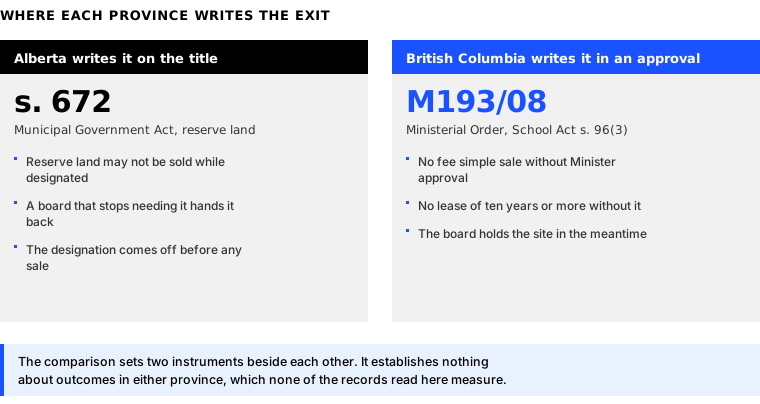
In Alberta the constraint on a school site sits on the certificate of title, and a board that stops needing reserve land transfers it to the municipality by statute.
Two provinces answer the same narrow question in different places. When a school board stops needing a site, Alberta’s answer is written on the certificate of title, and the default destination is the municipality. British Columbia’s answer is written in a Ministerial Order, and until an approval is granted the board keeps holding the land. Since 2025 Alberta has added a second path, running through the Crown.
This series reads one school district, and this piece reads none. Jurisdictions compare at the level of their instruments, and the question put to both provinces here is narrow. A school board stops needing a site. Something in the instrument decides what happens next, and the two provinces write that decision in different documents.
In Alberta the constraint sits on the certificate of title.
Land dedicated when a parcel is subdivided in Alberta carries a designation registered against the title. The Land Titles procedure governing those designations names four: municipal reserve, school reserve, municipal and school reserve, and environmental reserve1.
The procedure states the restriction against section 671 of the Municipal Government Act. “While land is designated as reserve, it may not be sold, leased or otherwise disposed of.”1 It states the release in the same place. “Once a reserve designation is removed, a municipal council or school authority may sell, lease or otherwise dispose of the land.”1
So in Alberta the first act in any disposal of reserve land is the removal of a designation from a certificate of title. The procedure records the mechanics of that removal: on registration, “the reserve designation is removed from the lot(s) involved by cancelling the certificate(s) of title and issuing new certificate(s) of title.”1
The default destination is written down as well. The procedure states section 672 as follows: if a school authority no longer needs school reserve or municipal and school reserve land, “the school authority must transfer the land or its interest in the land to the municipal corporation of the municipality in which the SR or MSR is located.”1 The same relationship runs the other way under section 673, where a council may transfer municipal reserve or its interest in municipal and school reserve to a school authority, and the designation becomes school reserve on registration1.
The consolidation of the Act current to 1 April 2024 carries those provisions under headings that describe them accurately: section 666, municipal and school reserves; section 671, use of reserve land and money; section 672, transfer of school and other reserves to municipality; section 674, requirement for hearing2.
Since 2025 a second Alberta path runs through the Crown.
Bill 51, the Education Amendment Act, 2025, of the First Session of the 31st Legislature, adds sections to the Education Act that change who holds new school land3.
Section 186.1 supplies the definitions. An approved new school project is a project approved under section 195(1) for new buildings, for repurposing an existing building as a school, or for site preparation, and it excludes purchases, relocations, renovations and extensions. New school real property is a parcel in which an owner holds a fee simple interest under the Land Titles Act. An owner is a board or a municipality, or both together where the parcel is held jointly or as tenants in common3.
Section 187.1 supplies the mechanism. The owner’s interest transfers to the Crown on two conditions: the Minister provides the owner with written notice of the transfer, and 45 days pass after the day the notice is provided. On expiry, ownership “is considered to have legally transferred to the Crown”, the Minister requests a new certificate of title, and “the transfer is not to be treated as an expropriation under the Expropriation Act”3.
What the owner receives is set out in the same section. The Minister “may pay to the owner the amount determined in accordance with the regulations, if any”, and “must, in accordance with the regulations, if any, offer a leasehold interest in the new school real property to each board”3.
The province describes the effect of the amendments as enabling “the Ministry of Infrastructure to own new kindergarten to Grade 12 schools and playgrounds and lease them to school boards, francophone school boards and charter schools for operation and maintenance”. The same page states that the Act received Royal Assent on 15 May 2025 and that “[a]mendments related to school property ownership came into effect on March 27, 2025”4.
In British Columbia the constraint sits in an approval.
British Columbia writes the constraint into a Ministerial Order rather than onto a title. Ministerial Order M193/08, effective 3 September 2008 under School Act sections 96(3) and 168(2)(t), states that a board “must not dispose of land or improvements by sale and transfer in fee simple or by way of a lease of 10 years or more unless such disposal is to another board or an independent school for educational purposes or is approved by the Minister”5. The same order permits a lease shorter than ten years to an agency or body taking the property for an alternative community use5.
The provincial policy page adds the standard and the sale route. “Only in exceptional circumstances should a board consider permanently disposing of school property.” Property sold for a use that is neither educational nor community must go to “public tender or other competitive bidding process”6.
The board-level policy sets out the sequence: Vancouver School Board Policy 20, adopted 24 September 2018 and amended 27 September 2021, runs six steps: a title search confirming fee simple and any Crown grants or charges; consultation on future enrolment growth and alternative community use; a Board resolution declaring the property surplus, followed by survey plans and a public tender or request for proposals, with exceptions for not-for-profits, public authorities, land exchanges and adjacent-land consolidation, then an application for Minister approval with appraisals; adoption of a Real Property Disposal By-law confirming that the land is no longer required for future educational purposes; notification of the Minister; and transfer of title78.
Nothing in that sequence names a destination. Until an approval is granted, the board continues to hold the land.
The two paths beside each other.
| The question | Alberta | British Columbia |
|---|---|---|
| Where the constraint is written | On the certificate of title, as a reserve designation | In a Ministerial Order made under the School Act |
| What blocks a sale | The designation itself. Reserve land may not be sold, leased or otherwise disposed of, section 671 | Absence of Ministerial approval for a fee simple sale or a lease of ten years or more, M193/08 |
| Default destination when a board stops needing the site | The municipal corporation of the municipality, section 672 | None named. The board continues to hold the land |
| Who takes title to a new school site | The Crown, on written notice and 45 days, Education Act section 187.1 | The board, in fee simple |
| What the board holds afterwards | A leasehold interest offered by the Minister | The title it already holds |
| Route to a market sale | Removal of the reserve designation first, then sale permitted | Surplus resolution, public tender or proposals, Minister approval, disposal by-law |
The two instruments were also set in different decades. The British Columbia order took effect on 3 September 2008, and the Alberta property-ownership amendments took effect on 27 March 2025, sixteen years and 205 days later9.
What could not be read, and what follows from that.
Alberta also has a Disposition of Property Regulation made under the Education Act10. It could not be read at origin for this piece. The Alberta King’s Printer copy and the CanLII copy are both excluded by the robots rules on those sites, and the Government of Alberta open publications service returned a server error on every attempt.
So this piece states nothing about what that regulation requires. In particular it makes no claim that Alberta obliges a board to offer a surplus site to other public bodies in a set order before a market sale. That proposition is common in secondary summaries, it was not verified here, and it is carried below as an open gate rather than as a finding.
The scope of this comparison.
Nothing above is a judgment on either province. The records establish where each instrument places its constraint, and nothing about which arrangement produces better-maintained buildings, more school sites, or fewer disputes, because none of these documents measures any of those things.
The Alberta reserve provisions govern land that carries a reserve designation. Not every school site in Alberta does, and the records read here do not establish what share does. The Crown-transfer provisions in section 187.1 apply to new school real property in an approved new school project, and section 260.21 carries transitional language for titles registered before the amendments came into force3. Existing sites are outside that mechanism.
The Ministerial Order in British Columbia governs disposals. It does not govern closure, which runs under a separate order and a separate board policy.
What the two instruments share.
Both provinces put a public body between a school site and the open market, and both make the point of interception a documented act with a date on it. In Alberta the act is a registration against a title. In British Columbia the act is an approval on a file.
The difference a record can see is where each act generates its evidence. A designation on a certificate of title exists whether or not anyone is looking for it, and it is searchable by parcel. An approval exists in a file, indexed by the body that granted it, and a reader looking for the full set has to know which files to ask for.
That difference is descriptive and it stops there. Alberta has not solved anything Vancouver has failed to solve; it has written one consequence into a place a reader will find it.
Sources
-
Alberta Land Titles and Surveys, procedure SUR-10, Surveys, Removal or Change of Reserve Designation, 1 January 2021. The four reserve designations registered against title, the section 671 restriction that reserve land may not be sold, leased or otherwise disposed of while designated, the release once the designation is removed, the section 672 obligation on a school authority to transfer school reserve or municipal and school reserve it no longer needs to the municipal corporation, the section 673 transfer in the other direction, and the mechanics of removal by cancelling and reissuing certificates of title. ↩ ↩2 ↩3 ↩4 ↩5 ↩6
-
Municipal Government Act, RSA 2000, c M-26, consolidation current as of 1 April 2024, in the copy published by the City of Calgary Assessment Review Board. The consolidation date and the section headings for section 666, municipal and school reserves, section 671, use of reserve land and money, section 672, transfer of school and other reserves to municipality, and section 674, requirement for hearing. Only the headings and the consolidation date were read in this copy. The operative wording of the reserve provisions is quoted above from source 1, which quotes it directly. ↩
-
Legislative Assembly of Alberta, Bill 51, Education Amendment Act, 2025, First Session, 31st Legislature. New Education Act section 186.1 and its definitions of approved new school project, new school real property and owner; section 187.1, the written notice, the 45 days, the transfer to the Crown, the request for a new certificate of title, the statement that the transfer is not to be treated as an expropriation under the Expropriation Act, the payment provision and the obligation to offer a leasehold interest to each board; the regulation-making power in section 194; and the transitional language in section 260.21. ↩ ↩2 ↩3 ↩4 ↩5
-
Government of Alberta, Strengthening Alberta’s education system, page last updated 15 May 2025. Royal Assent for the Education Amendment Act, 2025 on 15 May 2025, the statement that amendments related to school property ownership came into effect on 27 March 2025, and the description of the Ministry of Infrastructure owning new kindergarten to Grade 12 schools and playgrounds and leasing them to school boards, francophone school boards and charter schools. ↩
-
British Columbia, Ministerial Order M193/08, Disposal of Land or Improvements Order, effective 3 September 2008, made under School Act sections 96(3) and 168(2)(t). The prohibition on disposal in fee simple or by a lease of ten years or more without Ministerial approval, the exception for disposals to another board or an independent school for educational purposes, and the permission for shorter leases for an alternative community use. ↩ ↩2
-
Province of British Columbia, School Building Closure and Disposal, Ministry policy page. The statement that only in exceptional circumstances should a board consider permanently disposing of school property, and the requirement that property sold for a use that is neither educational nor community go to public tender or another competitive bidding process. ↩
-
Steps between a title search and a transfer of title under Vancouver School Board Policy 20: six.
title search + consultation + surplus resolution with tender and Minister application + disposal by-law + Minister notification + transfer = 6A count of the steps as the policy sets them out, not a measure of elapsed time or difficulty. The third step contains several actions inside it, and the policy also records Board commitments of 2015 and 2021 that sit alongside the sequence rather than inside it. ↩ -
Vancouver School Board, Policy 20, Disposal of Land or Improvements, adopted 24 September 2018, amended 27 September 2021. The six-step disposal sequence from title search to transfer of title, the exceptions to public tender, the Real Property Disposal By-law, and the Board commitments of 2015 and 2021 recorded in the policy. ↩
-
Interval between the two operative instruments: sixteen years and 205 days.
3 September 2008 to 27 March 2025 = 16 years, 205 daysMeasured from the effective date of the British Columbia order to the date the Government of Alberta states the property-ownership amendments took effect. It establishes only that the two instruments were set in different decades, and says nothing about which is more current in substance. ↩ -
Open gate: the regulation has not been read at origin. Alberta, Disposition of Property Regulation, Alta Reg 86/2019, made under the Education Act [no public URL located]. The regulation exists as Alta Reg 86/2019. Both the provincial King’s Printer and the public case-law mirror disallow automated retrieval, so the text has not been read. Every Alberta statement in this piece therefore rests on the Municipal Government Act reserve provisions and on Bill 51, and the regulation is treated as unread. ↩