The Split Record A personal column by Vik Khanna, published Mondays.
One district, four horizons
The published long range plan states a ten-year horizon to 2031. The closure decision used a projection set running to 2039. One committee report runs three horizons at once, with charts reaching 2050.
The Vancouver School Board’s published long range plan states a ten-year enrolment horizon to 2031, with some projections to 2036. The closure decision of December 2025 used a set running to 2039. A committee report of June 2025 runs three horizons at once and carries charts reaching 2050. Five projection sets appear in that one report. The Ministry floor is ten years as a minimum, and everything above the floor is a local choice that no document records making.
A forecast horizon looks like a technical setting. It is the year a projection stops, and nobody argues about it, nothing turns on it in a public meeting, and it does not appear in any headline.
It also decides what a decision is allowed to see. A projection that stops in 2031 cannot show what happens in 2035. A body reading it has been handed a window rather than a misstatement, and the window was chosen by somebody, somewhere, without a record of the choice.
So this piece does one thing. It counts the horizons in use in a single district and puts the count on a page.
Five projection sets, one committee report.
The Facilities Planning Committee report of 16 June 2025, authored by Jessie Gresley-Jones, Executive Director of Facilities, and James de Hoop, Senior Manager of Planning, presents five separate enrolment projection sets1.
| Projection set | Produced by | Dated | Where it appears |
|---|---|---|---|
| Baragar Baseline | Baragar Systems | November 2024 | Facilities Planning, 16 June 2025 |
| Baragar with Local Knowledge Added | Baragar Systems with district input | April 2025 | Facilities Planning, 16 June 2025 |
| BC Stats | BC Stats | February 2025 | Facilities Planning, 16 June 2025 |
| MECC | Ministry of Education and Child Care | December 2024 | Facilities Planning, 16 June 2025 |
| Metro Vancouver | Metro Vancouver | March 2024 | Facilities Planning, 16 June 2025 |
Four producers, five sets, five dates spread across sixteen months, all of them in one document about one district’s schools1. Presenting them together is good practice, and I want to say that before anything else. A report that shows five projections is a report that admits the future has a range.
The difficulty starts one step later, when a decision has to pick one.
What the published plan states its horizon to be.
The operative long range facilities plan for the district is the 2020 plan, approved by the Board on 25 January 2021, published as the 2020 Long-Range District Overview, 2021 Update of May 20222. No newer long range facilities plan has been published.
It states its own horizon in a sentence: the enrolment data in the plan is from September 2021, and the enrolment projections are for a ten-year planning horizon to 2031. It also states that some District projections are for a fifteen-year planning horizon to 20362. Appendix E is titled School Enrolment Forecasts, and its range runs 2022 to 20312.
So the published plan carries two horizons on its own, and its enrolment base is now five years and one month old3. The plan itself has been in force for five years and 274 days4.
What the decision actually used.
The closure decision did not run on the published plan’s horizon. The engagement summary of 10 December 2025 states that the Baragar projections with local knowledge “only extend to 15 years into the future”5. The projections presented at the information session of 28 October 2025 run to 20396, and staff told the Board that the three receiving schools “are projected to be able to accommodate the projected student enrolment for the next 14 years”7.
Fourteen years from 2025 reaches 2039. That is a third horizon, eight years beyond the one the published plan states, and it is the horizon that carried the decision.
Three horizons inside one committee report.
The June 2025 committee report does not settle on one either. It works in three at once. A short term of the next three years. A medium term described as a ten to fifteen-year horizon. A long term described as a fifteen to thirty-year horizon. Its charts span 2033 to 20501.
That is a defensible structure for a facilities report, and it is a fourth horizon in the same district in the same year.
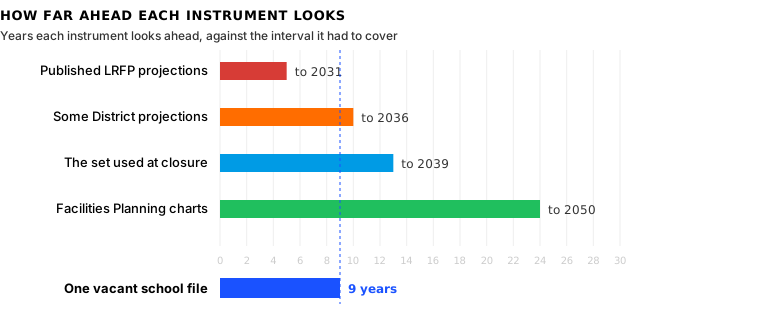
The four end years sit 19 years apart from the nearest to the furthest8, and every one of them is published by the same district9.
The floor, and everything stacked above it.
The Ministry sets a floor and no ceiling. Its Long-Range Facilities Plan Guidelines state that a long range facilities plan “is expected to cover a 10-year timeframe, at a minimum”10.
Every horizon above ten years is therefore a local choice, and that is the part I keep returning to. A floor is a rule. Everything above a floor is discretion, and discretion that no document records exercising is discretion that cannot be reviewed.
| Horizon in use | Ends | Stated in | Years ahead of 2026 |
|---|---|---|---|
| Ministry minimum for a long range plan | ten years, as a floor | LRFP Guidelines, April 2019 | n/a |
| Published LRFP enrolment projections | 2031 | District Overview, May 2022 | 5 |
| Some District projections | 2036 | District Overview, May 2022 | 10 |
| The set carried into the closure decision | 2039 | Info session slides and engagement summary, 2025 | 13 |
| Facilities Planning long-term charts | 2050 | Facilities Planning report, 16 June 2025 | 24 |
Nothing in the published record states which horizon governs which determination. A surplus finding, a receiving-capacity finding, a capital priority and a boundary review could each take a different one from that table and each be quoting the district correctly.
Who produces the numbers, and what is published about how.
The projections are produced by Baragar Systems, an external vendor, with what the district calls local knowledge added1. The inputs are named: actual enrolment reports, the birth registry from Vital Statistics BC, and Canada Child Benefit recipient data, run through a population-based participation rate model1.
Naming the inputs is more than many districts publish. What is absent is the method: Baragar is proprietary software, and no algorithm, no parameter set and no reproducible specification appears in the published record11.
That combination matters more than the horizon count. A second analyst holding the published inputs cannot reproduce the 2039 figures, so a reader who wants to test the projection has one option, which is to accept it. The technical method stands as an open gate below, and this piece treats the reproducibility of those figures as unresolved.
None of this says any projection is wrong. Five sets in one report is a district showing its uncertainty rather than hiding it, and the horizons themselves are each reasonable for their own purpose. Demographers stop projecting where the error bars swallow the signal. Facilities planners look further because buildings last longer. Both are right on their own terms.
It also reads one district; whether four horizons in one year is usual or unusual would take a count across districts, and no such count appears here.
A horizon becomes an argument nobody makes.
The first cost is that a horizon becomes an argument without anyone making it. A projection ending in 2031 cannot show a 2035 pressure, so a body reading it sees a settled picture where a longer window would have shown a rising one, or the reverse. Nobody argued for that outcome. The window produced it.
The second cost is comparability inside one file. When a capacity case runs on the 2039 set and a capital priority runs on the 2031 set, the two are describing different futures with the same vocabulary, and no page in either document says so.
The third cost is the one I find hardest to price. A decision that commits land is effectively permanent. The projection that supported it will be revised many times inside the life of that commitment, and by the district’s own published cycle the revisions arrive faster than the plan does: the plan dates from 2021 and its data from September 20213, while the projection sets in the June 2025 report carry dates from March 2024 to April 20251. The evidence refreshes on one clock, the plan on another, and the commitment on neither.
A horizon statement at the top of every report.
A horizon statement, printed at the top of any table of projections and beside any recommendation that relies on one. Four fields: the end year, the producer, the date the set was produced, and the determination the set is being used for.
That is a header, not a policy, and it costs four lines. It would have made the June 2025 report state, on its face, which of its five sets was carrying which conclusion, and it would have made the December 2025 report state that its case ran to 2039 while the district’s published plan runs to 2031.
So I conclude that the horizons are the argument. A decision tested against 2039 and a plan reaching 2031 are not in conflict on their face, and the difference does the work of an argument nobody has to make. Four horizons in one district is not a failure of rigour. It is an absence of a rule.
Whether that changes an answer is for the people who take the votes, and the record shows them documenting each step they took. The record’s own job stops before the vote. What it can stop doing is letting the year a projection happens to end make a silent argument on the way past.
Sources
-
Vancouver School Board, Facilities Planning Committee agenda, 16 June 2025, report of Jessie Gresley-Jones, Executive Director of Facilities, and James de Hoop, Senior Manager of Planning. The five projection sets and their producers and dates, the short term of the next three years, the ten to fifteen-year and fifteen to thirty-year horizons, the chart span from 2033 to 2050, the named inputs of enrolment reports, the Vital Statistics BC birth registry and Canada Child Benefit recipient data, and the population-based participation rate model. ↩ ↩2 ↩3 ↩4 ↩5 ↩6
-
Vancouver School Board, 2020 Long-Range District Overview, 2021 Update, May 2022, being the operative published document of the 2020 Long Range Facilities Plan approved by the Board on 25 January 2021. The ten-year planning horizon to 2031, the statement that some District projections are for a fifteen-year planning horizon to 2036, the September 2021 enrolment base, the title and range of Appendix E, and that no newer long range facilities plan has been published. ↩ ↩2 ↩3
-
Age of the enrolment base inside the published plan: five years and one month.
September 2021 to October 2026 = 5 years, 1 monthThe plan states that its student enrolment data is from September 2021. The month is published without a day, so the interval is stated in months. It measures the age of the base year, not the age of any projection built on it. ↩ ↩2 -
Age of the operative long range facilities plan at publication: five years and 274 days.
25 January 2021 to 26 October 2026 = 5 years, 274 daysMeasured from the Board approval date of the 2020 plan. The operative published document is the District Overview 2021 Update of May 2022, so the readable text is younger than the approval. No newer long range facilities plan has been published. ↩ -
Vancouver School Board, Sir Guy Carleton closure consideration, engagement summary report, 10 December 2025. The statement that the Baragar projections with local knowledge extend only fifteen years into the future. ↩
-
Vancouver School Board, Sir Guy Carleton closure consideration, public information session slide deck, 28 October 2025. The projected enrolment figures for the three receiving schools at 2039, which fix the end year of the set used in the closure case. ↩
-
Vancouver School Board, Proposed Closure of Sir Guy Carleton Elementary School, report of the Superintendent, Special Board Meeting Agenda (Revised), 17 December 2025. The staff statement that the receiving schools are projected to be able to accommodate the projected student enrolment for the next fourteen years. ↩
-
Distance between the nearest and furthest published end years: 19 years.
2050 − 2031 = 19The gap between the end of the published long range plan projections and the end of the charts in the June 2025 committee report. Both are published by the same district. The figure sizes the range of windows in use and implies nothing about which window is appropriate for any determination. ↩ -
Distance from 2026 to each published end year: five, ten, thirteen and 24 years.
2031 − 2026 = 5; 2036 − 2026 = 10; 2039 − 2026 = 13; 2050 − 2026 = 24Whole-year subtraction from the year of publication of this piece. Each end year is quoted from a named record. The subtraction measures how far each instrument reaches from today and says nothing about the quality of any projection inside its window. ↩ -
Ministry of Education, Long-Range Facilities Plan Guidelines, April 2019, published as Appendix O to the Vancouver School Board Long Range Facilities Plan. The Ministry expectation that a long range facilities plan covers a ten-year timeframe as a minimum, which sets a floor and no ceiling. ↩
-
Checked, not published. Baragar Systems, the technical method behind the district enrolment projections: the algorithm, the parameter set, and a specification a second analyst could reproduce [no public URL located]. Looked for and absent from public. The district publishes two named variants, a baseline and a version with local knowledge added that integrates development yields and local data. The algorithm, the parameter set, and any specification a second analyst could run are proprietary to the vendor and are published nowhere. Reproducibility is therefore unresolved on the public record. ↩