Primary Sources The documents themselves, cited. Published Wednesdays.
Three fifths of the record arrived after a search complaint
An adjudicator read a Vancouver board's land records in 2025 and ordered part of them open. Of the 362 pages released across four packages, 217 surfaced only after a complaint that the search had been inadequate.
An applicant asked a Vancouver school board for its land surveys and subdivision documents. The records came in four packages, and one of them, carrying 217 pages, followed a complaint that the search had been inadequate. Order F25-85 then decided what could be withheld. This piece counts the packages, lists the records the order names, and sets one of those names beside a page the district still writes in the future tense.
The order, and what it decided.
Order F25-85, neutral citation 2025 BCIPC 99, was issued on 29 October 2025 by adjudicator Jay Fedorak of the Office of the Information and Privacy Commissioner for British Columbia. The respondent public body is the Board of Education of School District 39 (Vancouver). The file number is F23-941681.
The request is quoted in the order’s opening paragraph: “copies of all land surveys conducted on real property owned by the Board from 2016 and copies of any subdivision documents relating to those properties having land surveys”1.
Four provisions of the Freedom of Information and Protection of Privacy Act were at issue: section 25(1)(b), disclosure in the public interest; section 12(3)(b), local public body confidences; section 13(1), advice or recommendations; and section 17(1), harm to financial or economic interests1.
The order describes what the records cover. At paragraph 17: “The records at issue comprise internal and external communications and documentation regarding the Board’s parcels of real property identified as surplus”1.
It also records the size of the district. At paragraph 15 the Board is described as operating “89 elementary and 18 secondary schools” and providing educational services to “approximately 48,500 students”1.
Compliance was required by 11 December 2025, forty-three days after the order was issued21.
Four releases, counted.
| Release | Pages | What the order says produced it | Paragraph |
|---|---|---|---|
| First | 19 | The Board’s initial response to the request | 2 |
| Second | 15 | Records the Board said it had overlooked | 2 |
| Third | 111 | A further disclosure in the same response process | 2 |
| Fourth | 217 | Resolution of a complaint that the search was inadequate | 4 |
The four figures total 362 pages3. The first three releases together come to 1454. The fourth release, on its own, is 59.9 per cent of everything eventually produced5.
The order states the second release in one sentence: “The Board subsequently informed the applicant that it had overlooked additional responsive records and provided 15 more pages of records” (paragraph 2)1.
The complaint that produced the fourth release.
The fourth package has a different origin from the first three. At paragraph 4 the order records: “The applicant also complained that the Board had failed to conduct an adequate search for records in accordance with s. 6(1) of FIPPA. The OIPC resolved the adequate search complaint under a separate file, which is not at issue in this inquiry.” That resolution “resulted in the Board disclosing a further 217 pages of responsive records, and the severing of those records is at issue in this inquiry”1.
So a tranche of 217 pages entered the file through a separate complaint process rather than through the original request, and the inquiry that produced this order then had to rule on how those pages had been severed.
The order also records two handling matters. At paragraph 10 the Board did not provide clear page numbers and did not identify, against each severed passage, which FIPPA exception it was applying. At paragraph 11 it later added section 13(1) to passages to which it had not previously applied that exception, “long after the close of submissions and without providing the applicant an opportunity to respond”. At paragraph 13 the adjudicator declined to accept what he described as, in effect, a third round of submissions, finding it “would prejudice the interests of the applicant, who has already waited through a second round of submissions”1.
What the order names on the record.
The order names several documents that no district page indexes. Each is recorded here with its paragraph number and nothing added.
- A Land Asset Strategy Report, described at paragraphs 79 and 80 as a strategic report provided by a third party expert consultant, containing “a lengthy analysis” of the Board’s land holdings, “identification of Potential Surplus Sites, and advice and opinion on the means through which the Board could potentially generate additional capital funds and return on investment”.
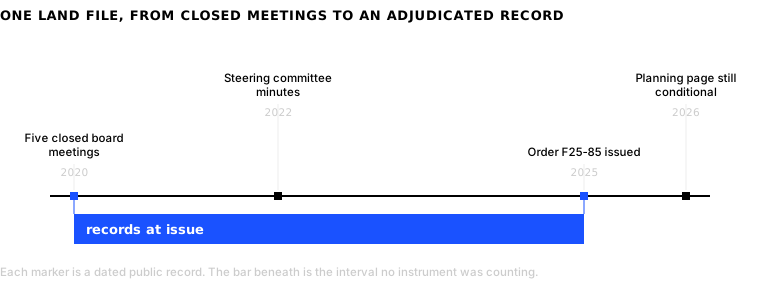
- Minutes of the Land Asset Strategy Implementation Steering Committee meeting of 26 April 2022, at paragraph 82.
- Five meetings held in the absence of the public in 2020, at paragraph 43: 29 June, 31 August, 9 September, 21 September and 28 September.
- A Short Term Opportunities Plan, referred to at paragraph 111 in the applicant’s submission that the Board had already made it public.
- An appraisal and further valuation and marketing material, addressed at paragraphs 141 to 143.
The five closed meetings span 91 days6.
The strategy the public page describes in the future tense.
The district’s Long Term Planning page describes a document that does not yet exist7. It states that when the results of Land Asset Management Studies identify opportunities to generate new revenues through the lease or disposition of surplus land holdings, the District will develop a Land Asset Strategy. No such document is linked, named, versioned or dated on that page, and two indexed addresses for it return a 4048.
The order names a Land Asset Strategy Report already in the Board’s hands, produced by a third party consultant, and upholds the withholding of pages of it1.
Neither record read states the relationship between the two. The page describes a strategy the District will develop. The order describes a report a consultant provided. Whether one is a step toward the other, a component of it, or a separate thing entirely is a question neither document answers, and no third record read resolves it.
What the two records establish together is narrower and firmer. A reader consulting the district’s published planning page finds a future-tense sentence. A reader consulting an adjudicated order finds a named report, a named steering committee, a meeting date and a set of withheld pages. Both readers are consulting public records about the same subject.
What was ordered open, and what was upheld as closed.
| Provision | Ordered disclosed | Upheld as withheld | Paragraphs |
|---|---|---|---|
| s. 12(3)(b) | Agenda item descriptions, subject titles, background sections, attendee and trustee movement information | The substance of deliberations, including the content of motions and how trustees voted | 55 to 68 |
| s. 13(1) | Long runs of pages found to carry no advice or recommendations | Consultant advice, staff recommendations to the City, passages of the strategy report and steering committee minutes | 79 to 110 |
| s. 17(1) | The identity of particular properties, where the harm case was found unproven | Detailed financial, valuation and marketing information at pages 63, 112 to 215, 216 to 279 and 280 to 283, under s. 17(1)(f) | 129 to 143 |
| s. 25(1)(b) | Nothing. The public interest override was found inapplicable | Not applicable to this provision | 32 and 33 |
On section 12(3)(b) the order states at paragraph 57 that “descriptions of the agenda items merely consist of the ‘subjects’ of deliberations and not the substance”, and at paragraph 67 that attendee and movement information “does not reveal the substance of the deliberations”1.
On section 17(1) the order states at paragraph 139 that the Board “has not met this burden with respect to the single fact of the identity of particular properties”. At paragraph 141 it accepts that the valuation material “would be valuable to potential purchasers” and upholds the withholding of the pages listed above under section 17(1)(f)1.
Both halves are findings of the same order. The deliberative space was upheld where the order found deliberation, and the structural record around it was ordered open.
What the order states about public debate.
The public interest override in section 25(1)(b) failed. The reasoning at paragraph 32 records “no evidence to suggest that the land use decisions at issue are the subject of recent public debate”, and adds: “There is no evidence before me, for example, of any discussions in the media or the legislature”1.
At paragraph 33 the order records the state of the file itself: “the only decision that the Board has made regarding land disposition is one not to proceed with even considering these land use proposals”1.
Those two findings sit beside each other in the same order. One records an absence of public discussion. The other records a decision to leave the proposals unconsidered. The order states both as findings on the material before the adjudicator, and this piece carries them the same way.
This reads one order about one request to one board. Every count above comes from figures the order prints, and the total of 362 pages is arithmetic rather than a figure the order states3. Nothing here describes the content of any withheld page, because no withheld page has been read. The Land Asset Strategy Report is named here exactly as the order names it and no further. And a second order, in a second district, would have to show the same distribution of releases before that distribution could be called a pattern.
A published index of land records, listing each document.
A published index of land records, listing each document by title, date and author, without content. The order shows that such an index is available: it names a consultant report, a steering committee, a meeting date and a plan, and it holds at paragraphs 55 to 68 that subject titles, agenda descriptions and attendance information carry no deliberative substance and cannot be withheld on that ground.
An index of that kind decides nothing about disposal, publishes no valuation and reveals no deliberation. It states which records exist and when they were made, so that the first three releases and the fourth would have described the same universe of documents from the beginning.
Every figure above carries its paragraph number, the order is published in full at the Commissioner’s own site, and the arithmetic is shown at the end.
Further records read for this piece are set out in Sources.91011
Sources
-
Office of the Information and Privacy Commissioner for British Columbia, Order F25-85, 2025 BCIPC 99, adjudicator Jay Fedorak, 29 October 2025, Board of Education of School District 39 (Vancouver), OIPC file F23-94168. The order number, citation, adjudicator, date, respondent and file number; the wording of the request at paragraph 1; the four releases of 19, 15, 111 and 217 pages at paragraphs 2 and 4; the section 6(1) adequate search complaint and its resolution under a separate file; the handling findings at paragraphs 10 to 13; the description of the records at paragraph 17; the district size at paragraph 15; the five closed meeting dates at paragraph 43; the section 12(3)(b) findings at paragraphs 55 to 68; the Land Asset Strategy Report at paragraphs 79 and 80; the steering committee minutes of 26 April 2022 at paragraph 82; the Short Term Opportunities Plan at paragraph 111; the section 17(1) findings at paragraphs 129 to 143 including the pages upheld under section 17(1)(f); the section 25(1)(b) reasoning at paragraphs 32 and 33; and the compliance date at paragraph 145. ↩ ↩2 ↩3 ↩4 ↩5 ↩6 ↩7 ↩8 ↩9 ↩10 ↩11 ↩12 ↩13 ↩14
-
Days from the order to the compliance deadline: 43.
29 October 2025 to 11 December 2025 = 43 daysBoth dates are printed in the order, the second at paragraph 145. It measures the compliance window set under section 59(1) of FIPPA. ↩ -
Total pages released across the four packages: 362.
19 + 15 + 111 + 217 = 362The four figures are printed at paragraphs 2 and 4 of the order. The total is arithmetic performed here rather than a figure the order itself prints. It counts pages released and says nothing about pages withheld in full. ↩ ↩2 -
Pages released before the search complaint was resolved: 145.
19 + 15 + 111 = 145The sum of the three releases the order attributes to the original request process at paragraph 2. ↩ -
Days spanned by the five closed meetings named in the order: 91.
29 June 2020 to 28 September 2020 = 91 daysThe five dates are listed at paragraph 43. The span measures the distance between the first and last of them and establishes nothing about what any meeting covered. ↩ -
VTCo, The state between two policies, The Split Record, 21 September 2026. The reading of the closure and disposal policies against each other, and the finding that the district’s Long Term Planning page describes a Land Asset Strategy in the conditional future tense with no document attached. ↩
-
Vancouver School Board, Long Term Planning page. The conditional future tense describing a Land Asset Strategy the District will develop when Land Asset Management Studies identify opportunities, the absence of any linked, named, versioned or dated document, and the two indexed addresses that return a 404. ↩
-
Vancouver School Board, Policy 20, Disposal of Land or Improvements, adopted 24 September 2018, amended 27 September 2021. The disposal sequence in which a Board resolution declaring a property surplus precedes survey plans and a public request for proposals or tender, and the requirement for appraisals in the application for Minister approval. ↩
-
Province of British Columbia, Ministerial Order M193/08, Disposal of Land or Improvements Order, effective 3 September 2008. The requirement in section 6 that boards develop, implement and publish disposal policies and procedures consistent with the order, and the ten-year threshold above which a disposal requires Minister approval. ↩
-
Ministry of Education and Child Care, school building closure and disposal policy page. That only in exceptional circumstances should a board consider permanently disposing of school property, and that property sold for non-educational and non-community use goes to public tender or another competitive bidding process. ↩