The Split Record A personal column by Vik Khanna, published Mondays.
The short instrument is the one in use
A Vancouver board recommended transferring Queen Elizabeth Annex to the francophone authority by sale or long-term lease in April 2023.
In April 2023 a Vancouver board declared Queen Elizabeth Annex surplus and recommended transferring it to the francophone school authority, by sale or by long-term lease. Forty-two months later that instrument is unexecuted and the authority runs a school in the building under an arrangement it describes as short-term. This piece reads the recommendation, the occupancy and the order that draws a line at ten years.
There is a shape of public file that reads as stalled and turns out to be running. It carries a decision on the record, no instrument executed against that decision, and a building in daily use by the party the decision named.
Queen Elizabeth Annex is that file. For three years I read it as a site waiting for a transfer. Reading the counterparty’s own record changed what I think is happening, and the correction is worth setting out, because the same shape appears on a second Vancouver site.
What I now think is happening is ordinary and structural. Two instruments were available. One was recommended. The other was used. The one that was used is the one the governing order says least about.
What the Board decided, and what it recommended.
The Board approved the closure of Queen Elizabeth Annex on 6 June 2022, effective 30 June 2023. On 11 April 2023 it declared the property surplus, with a transfer to the francophone school authority recommended, by sale or by long-term lease1.
On the board record read for this series, no instrument on that recommended route has been executed12. From the surplus resolution to the date of this piece is forty-two months3.
Primary Sources of 31 August set out why that half of the file carries no dates: the closure policy states its intervals in days and the disposal policy states a sequence of steps2. This piece takes the other side of it, which is what happened in the building while the recommended instrument stayed unexecuted.
What is in the building now.
The francophone authority publishes its own account. In a release of 16 May 2025 it states: «L’annexe a fermé en juin 2023, ce qui a permis au CSF de louer l’immeuble à court terme et à l’annexe Rose-des-vents de voir le jour en septembre 2023.» The annex closed in June 2023, which allowed the authority to lease the building on a short-term basis, and the Rose-des-vents annex opened there in September 20234.
So the building has been occupied by the recommended transferee for about thirty-eight months5, running a school, under an arrangement its own occupant describes as short-term.
The records read do not state the term of that lease, its rent, its start date beyond the month, or its end date. What they establish is that the site stayed in educational use throughout the interval, on a different instrument from the one the resolution named.
The ten-year line, and which side of it each arrangement sits on.
Above the board sits Ministerial Order M193/08, effective 3 September 2008. Section 3 states that a board must not dispose of land or improvements by sale and transfer in fee simple, or by way of a lease of ten years or more, unless the disposal is to another board or an independent school for educational purposes, or the Minister approves it6. Section 4 states that a board may dispose by way of lease, other than a lease of ten years or more, where the disposition is to an agency or organisation for an alternative community use7.
The order therefore draws one line, at ten years, and treats the two sides of it differently.
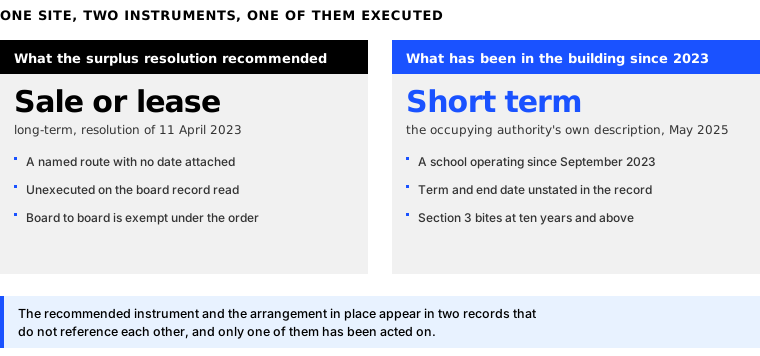
The recommended instrument sits inside section 3, and inside the exemption written into it, because a transfer to another board for educational purposes is one of the two routes the section names as proceeding without ministerial approval7.
The arrangement in place is described by its occupant as short-term, and no record read states which section of the order it was made under, or whether it was treated as a disposal at all.
That produces the finding I did not expect. Of the routes available on this file, the one carrying the fewest external approvals has produced no instrument in forty-two months3. The arrangement that has produced a school in the building for thirty-eight of those months5 is the one the order addresses least.
A second site, with a request and no instrument.
The same shape appears at Sir Guy Carleton. The francophone authority requested acquisition of that site in January 20241. The Board took third reading of the closure bylaw on 18 December 20258. No instrument stands on the record read12.
Thirty-four months have passed since the request9.
| Site | What the francophone authority did | Date | Instrument on the record read |
|---|---|---|---|
| Queen Elizabeth Annex | Named as recommended transferee in the surplus resolution | 11 April 2023 | None on the recommended route |
| Queen Elizabeth Annex | Leased the building and opened a school in it | September 2023 | A lease its occupant calls short-term |
| Sir Guy Carleton | Requested acquisition of the site | January 2024 | None |
| Sir Guy Carleton | Site closed by bylaw, third reading | 18 December 2025 | None. No surplus resolution taken |
Two sites, one counterparty, four dated steps, and one executed arrangement among them, on a route nobody recommended.
How long the request has been on the record.
The authority’s release also dates its own asking. «Le CSF inclut dans son plan immobilier annuel une demande pour une école à Vancouver à l’ouest de la rue Granville depuis au moins 2010.» It has included a request for a school in Vancouver west of Granville Street in its annual capital plan since at least 20104.
That is at least sixteen annual capital plans10, each one a document that entered a provincial process on a yearly cycle. The board record and the authority’s record both exist, both are dated, and neither carries the other.
The court record, and what this piece takes from it.
The same release names two decisions of the Supreme Court of British Columbia, 2023 BCSC 990 and 2023 BCSC 2123, and reports a decision of the Court of Appeal in May 2025 without giving its citation4. None of the three was read for this piece. The appeal decision prints below as an open gate11, and nothing above or below rests on any of them.
What was read is the Supreme Court of Canada’s own plain-language summary of Conseil scolaire francophone de la Colombie-Britannique v. British Columbia, 2020 SCC 13, docket 38332, judgment of 12 June 202012. That summary states that section 23 of the Charter means people whose first language is the minority language, or who went to primary school in that language, can send their children to school in that language. It describes a sliding scale under which minority-language students should receive their own school where the government gave one to the same number of majority-language speakers somewhere in the province. It records that the province was required to provide new French-language schools and to pay damages12.
That is a summary published by the Court for general readers, and it carries the Court’s own account of its holding. It is a different document from the judgment, and I have read the summary only. What any of these decisions requires of a board holding a surplus site is a question the judgments would answer, and the judgments stay unread here.
Nothing here argues that either site should be transferred, held, sold or leased, and nothing characterises the reasons of any board, authority or official, because the records read do not carry them. Boards hold sites open for documented reasons, including the reason that a counterparty is still settling what it needs. It reads two sites in one district on one date, against one order and one authority’s public release, and a third file would have to show the same shape before the shape could be called general.
Forty-two months of planning on both sides.
The first cost is to planning on both sides. A short-term arrangement with no stated end date is a poor basis for capital planning for whoever holds it, and the authority’s release records sixteen years of annual asking for a permanent facility west of Granville Street104. The board, meanwhile, carries a site it has declared surplus and cannot report as disposed of.
The second cost is to the reader. A family, a community organisation or a trustee elected after 2023 opens the board file and finds a closure, a surplus declaration, a recommendation, and no instrument. Opening the authority’s file instead, the same reader finds a school operating in the building. Both records are public. Neither points at the other.
The third cost is the one the ten-year line creates. A short arrangement below the threshold needs the least, so it is the one that can be made quickly. A long instrument above the threshold settles the question, so it is the one that takes a resolution, an approval or an exemption, and a date nobody has to set. The architecture makes the temporary answer cheap and the permanent answer slow, and neither of those effects was chosen by anyone administering it.
One line on the surplus resolution.
One line on the surplus resolution, and one line in the annual report that follows it. Where a board recommends a transfer to a named counterparty, the record states the instrument in place on the site in the meantime, its term, and the date the question next returns to a public meeting.
That changes nothing about what any board decides. A board that wants to keep leasing short-term keeps leasing short-term, in public, with a reason and a fresh date. A counterparty that wants to keep asking keeps asking, against a page that shows how long it has been asking.
None of that touches what a board may sign. It settles what a reader can establish without holding two files open at the same time.
What I take from the file is this. The short instrument is the one in use because a short instrument needs nobody’s approval. That is a rational response to the threshold, and it means the ten-year rule shapes what gets signed rather than what gets scrutinised.
If you sit on a body that has recommended a transfer, ask what instrument is on the site today and when it ends. On the records read here, both answers exist and neither is printed on the page that carries the recommendation.
Further records read for this piece are set out in Sources.13
Sources
-
Vancouver School Board, board decision record for Queen Elizabeth Annex and Sir Guy Carleton, 2022 to 2026: closure approved 6 June 2022 effective 30 June 2023, surplus declared 11 April 2023 with a transfer to the francophone school authority recommended by sale or long-term lease, and an acquisition request for Sir Guy Carleton in January 2024, assembled from the published agendas and minutes and retrievable through the district’s agendas and minutes search. The dated board decisions, the recommended route at Queen Elizabeth Annex, the January 2024 acquisition request at Sir Guy Carleton, and that no instrument on the recommended route has been executed on the record read. ↩ ↩2 ↩3 ↩4
-
VTCo, A recommendation has no execution date, The Split Record, 31 August 2026. The dated and undated halves of the Queen Elizabeth Annex file, the intervals stated in the closure policy against the steps stated in the disposal policy, and the state of the Sir Guy Carleton file as at that date. ↩ ↩2 ↩3
-
Time since the surplus resolution with the recommended instrument unexecuted: forty-two months.
11 April 2023 to 9 November 2026 = 42 months and 29 daysMeasured from the surplus declaration to the date of this piece. It measures elapsed time against the recommended route only, and the site has been occupied under a different arrangement for most of it. ↩ ↩2 -
Conseil scolaire francophone de la Colombie-Britannique, release on the Court of Appeal decision concerning the Queen Elizabeth Annex, 16 May 2025. The authority’s own statement that the annex closed in June 2023, that this allowed it to lease the building short-term, and that the Rose-des-vents annex opened there in September 2023; its statement that it has included a request for a school in Vancouver west of Granville Street in its annual capital plan since at least 2010; and its naming of 2023 BCSC 990 and 2023 BCSC 2123 together with a Court of Appeal decision in May 2025 for which no citation is given. ↩ ↩2 ↩3 ↩4
-
Time the francophone authority has run a school in the building: about thirty-eight months.
September 2023 to November 2026 = 38 monthsThe release gives the month rather than the day, so this is accurate to within a month. It establishes duration of occupancy and nothing about the terms of the arrangement. ↩ ↩2 -
Vancouver School Board, Policy 20, Disposal of Land or Improvements, adopted 24 September 2018, amended 27 September 2021. The position of the Board resolution declaring a property surplus in the disposal sequence, and the exceptions to a public request for proposals or tender that cover public authorities. ↩
-
Province of British Columbia, Ministerial Order M193/08, Disposal of Land or Improvements Order, effective 3 September 2008. Section 3, the prohibition on sale and transfer in fee simple or a lease of ten years or more without Minister approval, with the exemption for disposals to another board or an independent school for educational purposes; and section 4, the permission for leases shorter than ten years to an agency or organisation for an alternative community use. ↩ ↩2
-
Vancouver School Board, Proposed Closure of Sir Guy Carleton Elementary School, report of the Superintendent, Special Board Meeting Agenda (Revised), 17 December 2025. The closure process at Sir Guy Carleton and the readings that produced the closure bylaw in December 2025. ↩
-
Time since the acquisition request at Sir Guy Carleton: thirty-four months.
January 2024 to November 2026 = 34 monthsThe record gives the month of the request. The site has not reached a surplus resolution, so the disposal sequence has not begun to run on it. ↩ -
Annual capital plans carrying the same request: at least sixteen.
2026 − 2010 = 16The release states the request has appeared since at least 2010, so sixteen is a floor rather than a count. It measures how long the asking has been on the record and nothing about how any plan was treated. ↩ ↩2 -
Cited, not read at origin. Court of Appeal for British Columbia, 2025 BCCA 160, 16 May 2025, appeal by the parents’ society dismissed. The appellate outcome: the appeal dismissed and the findings below on process and reasonableness upheld. Closed on the Chief Executive research pass of 17 August 2026; the citation is recorded here and the judgment itself has not been read at origin by us. ↩
-
Supreme Court of Canada, Case in Brief: Conseil scolaire francophone de la Colombie-Britannique v. British Columbia, 2020 SCC 13, docket 38332, judgment 12 June 2020. The Court’s own plain-language account of what section 23 of the Charter guarantees, the sliding scale it describes, and its record that the province was required to provide new French-language schools and to pay damages. This is the Court’s summary for general readers and not the judgment. ↩ ↩2
-
Ministry of Education and Child Care, school building closure and disposal policy page. That only in exceptional circumstances should a board consider permanently disposing of school property, and the treatment of property sold for non-educational and non-community use. ↩