Primary Sources The documents themselves, cited. Published Wednesdays.
The plan comes before the fee
Washington charges $7,277 on a new single-family home in Redmond for school capacity.
A new single-family home in Redmond carries a school impact fee of $7,277 from 1 January 2026. The dollar figure is the visible part. The statute defines what the money may be spent on as a facility included in a capital facilities plan, and it sets out what that plan must contain, so the fee has nothing to attach to until a school district and a municipality have published one together. British Columbia runs a charge of the same family with a ceiling of $1,000 per unit set by regulation.
Washington State prices school capacity at the moment a home is permitted. The dollar figure is the part that gets quoted. The part that decides everything upstream of it sits in a definition.
The statute names school facilities.
The definitions section of the impact fee provisions defines public facilities as a list of four categories, and the third of them is “school facilities”1. An impact fee is defined as “[a] payment of money imposed upon development as a condition of development approval to pay for public facilities needed to serve new growth and development”1.
The authority is in section 82.02.050. Counties, cities and towns that are required or choose to plan under the Growth Management Act may impose impact fees on development activity, and three limits follow in the same section. Fees may be imposed only for system improvements “that are reasonably related to the new development”, may not exceed “a proportionate share” of the cost of those improvements, and are to be used for improvements that “will reasonably benefit the new development”1. The section was last amended in 2015, effective 1 September 20161.
The term doing the work in all three limits is system improvements, and it is defined as “[p]ublic facilities that are included in the capital facilities plan and are designed to provide service to service areas within the community at large”1.
The fee has nothing to attach to until the plan exists.
Because the object of the fee is defined as a facility inside a capital facilities plan, the plan is a precondition rather than a supporting document. And the contents of that plan are prescribed.
The Growth Management Act requires a capital facilities plan element containing an inventory of existing capital facilities owned by public entities, “showing the locations and capacities of the capital facilities”; “a forecast of the future needs for such capital facilities”; “the proposed locations and capacities of expanded or new capital facilities”; at least a six-year financing plan that identifies its sources of public money; and a requirement to reassess the land use element where probable funding falls short of existing needs2. The subsection was last amended in 20242.
One further sentence in the same subsection carries the reconciliation. A county or city is required to identify all public entities that own capital facilities and to work in good faith with them, special purpose districts among them, to gather and include their information in its own capital facilities element2. A school district is one of those entities, so the mechanism obliges a land use authority to collect a district’s inventory, capacity figures and forecast and carry them inside a municipal plan.
The ordinance imposing the fee is constrained in turn. It “shall include a schedule of impact fees” for each type of development activity, and “[t]he schedule shall be based upon a formula or other method of calculating such impact fees”1. Credit is required for a developer’s dedication of land, improvement or new construction, but only “to facilities that are identified in the capital facilities plan”1. Ordinances may exempt low-income housing and other development with broad public purposes, an early learning facility among them1.
What the money may pay for, and by when.
Section 82.02.070 governs the money after collection. Separate accounts are established for each type of public facility, and each jurisdiction reports annually on “the source and amount of all moneys collected, earned, or received and system improvements that were financed”1.
Expenditure is tied back to the plan: “[i]mpact fees for system improvements shall be expended only in conformance with the capital facilities plan element”1. And a clock runs. Fees “shall be expended or encumbered for a permissible use within ten years of receipt, unless there exists an extraordinary and compelling reason” documented in written findings1. The section was last amended in 20111.
| Step in the mechanism | What the instrument requires | Where it is written |
|---|---|---|
| School facilities are an eligible category | Public facilities is defined to include school facilities | RCW 82.02.090 |
| Who may impose a fee | Counties, cities and towns planning under the Growth Management Act | RCW 82.02.050(2) |
| What the fee may buy | System improvements, defined as facilities included in the capital facilities plan | RCW 82.02.090 |
| What the plan must contain | Inventory with locations and capacities, forecast of future needs, six-year financing plan, reassessment if funding falls short | RCW 36.70A.070(3) |
| Where the number comes from | A published schedule per development type, based on a formula or other method | RCW 82.02.060(1) |
| Where the money sits | Separate accounts by facility type, with an annual report | RCW 82.02.070(1) |
| The deadline on the money | Expended or encumbered within ten years of receipt, absent written findings | RCW 82.02.070(3) |
One city, one district, one dated number.
The City of Redmond publishes its schedule as a dated document. The 2026 Impact Fees Schedule, adopted by Ordinance 3240 and effective 1 January 2026, states that “[t]he City of Redmond collects development impact fees on behalf of Lake Washington School District (LWSD)”. The school impact fee is $7,277.00 per single-family dwelling unit and $170.00 per multi-family dwelling unit, and a school administration fee of $65.00 is assessed on top3. That brings a single-family unit to $7,3424.
The district publishes the other half: Lake Washington School District states that it “does not have independent authority to assess school impact fees”, and that King County and the cities of Kirkland, Redmond and Sammamish collect them on its behalf under adopted ordinances. Its six-year Capital Facilities Plan is updated annually and establishes the basis for collection. Rates effective 1 January 2025 were $5,972 single-family and nil multi-family; effective 1 January 2026 they are $7,277 and $170. The page is dated 24 June 20255.
The single-family figure therefore rose by $1,305 in one year, an increase of 21.9 per cent6. The district also states that a 50 per cent discount factor is applied after the formula runs, a factor negotiated when King County adopted its original ordinance in 19915.
The cycle is published elsewhere too. Snohomish County runs the same mechanism on a two-year cadence under chapter 30.66C of its county code, with ten school districts submitting plans, and states that the plans “expire on December 31” and that “the new plan becomes effective on January 1”7.
The British Columbia charge, and its ceiling.
British Columbia has a charge of the same family. The province describes the school site acquisition charge as “a charge per dwelling unit to be paid by residential developers”, collected by local government and transferred to school boards “to help them to fund for new school sites needed as a result of new residential development”, authorised under the Local Government Act and a regulation. That page carries a last-updated date of 2 April 20258.
The regulation sets the ceiling: B.C. Reg. 17/2000, deposited 28 January 2000 under Order in Council 70/2000 and consulted in the consolidation current to 30 May 2023 with amendments to B.C. Reg. 118/2018, sets a maximum charge per unit by density category: $1,000 at low density, $900 at medium low, $800 at medium, $700 at medium high and $600 at high density9.
The plan requirement is present in British Columbia as well. The Ministry implementation guide of February 2000 states that “[t]he Eligible School Sites Proposal is based on the school district’s long-term facilities plan” and that “[t]he long-term facilities plan should extend for at least ten years”. It also directs that proceeds “must be placed in a land capital reserve trust fund in the school board’s name”10.
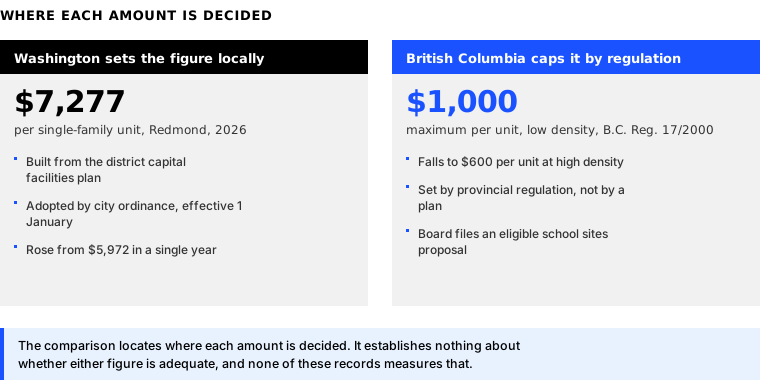
Set the two against each other and the Redmond single-family figure runs at 7.3 times the British Columbia maximum at low density and 12.1 times the maximum at high density11. That ratio compares an amount charged with a ceiling, and the two provinces and states fund school capital from different sources, so it sizes a design difference rather than a shortfall.
What the comparison establishes.
Both jurisdictions attach a residential charge to a school district’s forward plan, and both put a ten-year figure into the mechanism. In Washington the ten years is a deadline on spending the money. In British Columbia the ten years is a floor on how far the plan behind the charge must look.
The difference is where the amount is decided. In Washington it comes out of a district’s own adopted plan through a formula in a local ordinance, it is published as a dated schedule, and it moves: Redmond’s single-family figure moved 21.9 per cent between two consecutive 1 January dates6. In British Columbia the amount is bounded by a table in a provincial regulation, whatever a district’s plan says.
The structural consequence is the one this series measures every system by. The Washington mechanism obliges a land use authority to gather a school district’s capacity figures into its own plan, and then refreshes that obligation on a published cycle, annually at Lake Washington School District and biennially in Snohomish County57. The reconciliation is manufactured by the instrument rather than left to practice.
What the comparison leaves open.
Whether and how the school site acquisition charge operates inside the City of Vancouver is unresolved on the records read here12. The charge is authorised under the Local Government Act, the City of Vancouver operates under the Vancouver Charter, the provincial page does not address the point, and the implementation guide of February 2000 cites the Municipal Act sections that preceded the current numbering810. That question is carried as an open gate below, and nothing above rests on an answer to it.
Two further limits apply. The regulation sets maximums, so the rate in force in any given British Columbia municipality is a separate record that has not been read here. And the Washington figures are for one city and one district, while schedules differ jurisdiction by jurisdiction.
What both instruments have in common.
Each one turns a school district’s statement about future capacity into a document that another body is obliged to read on a date. In Washington the reading happens in a comprehensive plan and then at a permit counter. In British Columbia it happens when a board files an eligible school sites proposal with the local governments in its district.
Each one also converts a projection into an obligation with a deadline attached. A forecast that has to be reconciled with another body’s plan on a published cycle is a forecast somebody has to defend.
Whether a charge on new housing should exist, and at what level, is a question for legislatures and councils. What these two instruments show is that a reconciliation between a school plan and a land use plan can be produced by an instrument rather than left to whoever happens to ask.
Sources
-
Revised Code of Washington, chapter 82.02, impact fee provisions at sections 82.02.050, 82.02.060, 82.02.070 and 82.02.090. The definition of public facilities as including school facilities and of system improvements as facilities included in the capital facilities plan, at 82.02.090; the authority of counties, cities and towns planning under the Growth Management Act to impose fees and the three limits on them, at 82.02.050, last amended in 2015 with effect from 1 September 2016; the required schedule based on a formula or other method of calculation, the credit for dedications to facilities identified in the capital facilities plan, and the permitted exemptions, at 82.02.060, last amended in 2025; and the separate accounts, the annual report, the requirement that expenditure conform to the capital facilities plan element and the ten-year expend-or-encumber rule, at 82.02.070, last amended in 2011. ↩ ↩2 ↩3 ↩4 ↩5 ↩6 ↩7 ↩8 ↩9 ↩10 ↩11 ↩12
-
Revised Code of Washington, section 36.70A.070(3), the capital facilities plan element of the Growth Management Act. The prescribed contents of a capital facilities plan element, namely the inventory showing locations and capacities, the forecast of future needs, the proposed locations and capacities of expanded or new facilities, the six-year financing plan, and the reassessment requirement; and the duty on a county or city to identify all public entities owning capital facilities and to work in good faith with them, special purpose districts among them, to gather their information. Last amended in 2024. ↩ ↩2 ↩3
-
City of Redmond, 2026 Impact Fees Schedule, adopted by Ordinance 3240, effective 1 January 2026. That the City of Redmond collects development impact fees on behalf of Lake Washington School District, the school impact fee of $7,277.00 per single-family dwelling unit and $170.00 per multi-family dwelling unit, and the $65.00 school administration fee assessed on top. ↩
-
Total school charge on a single-family unit in Redmond in 2026: $7,342.
7,277 + 65 = 7,342The school impact fee plus the school administration fee, both stated on the same schedule. It excludes every other impact fee on that schedule, so it understates the total development charge on a unit. ↩ -
Lake Washington School District, impact fees page, last updated 24 June 2025. That the district has no independent authority to assess impact fees and that King County and the cities of Kirkland, Redmond and Sammamish collect them on its behalf; the six-year Capital Facilities Plan updated annually as the basis for collection; rates of $5,972 single-family and nil multi-family effective 1 January 2025 and $7,277 and $170 effective 1 January 2026; and the 50 per cent discount factor negotiated at King County’s original 1991 ordinance. ↩ ↩2 ↩3
-
Change in the Redmond single-family school impact fee between 2025 and 2026: $1,305, or 21.9 per cent.
7,277 − 5,972 = 1,305; 1,305 ÷ 5,972 = 0.2185, rounded to 21.9 per centBoth figures are published by the district as rates effective on consecutive 1 January dates. The change reflects a recalculation under the district capital facilities plan, and nothing here identifies which input moved. ↩ ↩2 -
Snohomish County, biennial update to school district capital facilities plans. That the county runs the mechanism under chapter 30.66C of the Snohomish County Code with ten school districts submitting plans, and that the plans expire on 31 December with the new plan effective on 1 January. ↩ ↩2
-
Province of British Columbia, School Site Acquisition Charge, Ministry of Education capital planning page, last updated 2 April 2025. The description of the charge as a per dwelling unit charge paid by residential developers, collected by local government and transferred to school boards for new school sites needed as a result of new residential development, and its authority under the Local Government Act and the regulation. ↩ ↩2
-
British Columbia, School Site Acquisition Charge Regulation, B.C. Reg. 17/2000, deposited 28 January 2000 under Order in Council 70/2000, consolidation current to 30 May 2023 including amendments to B.C. Reg. 118/2018. The maximum school site acquisition charge per unit by density category: $1,000 at low density, $900 at medium low, $800 at medium, $700 at medium high and $600 at high density. ↩
-
Ministry of Education, Implementation Guide: School Site Acquisition Charge, February 2000. That the eligible school sites proposal is based on the school district’s long-term facilities plan and that the plan should extend for at least ten years, that proceeds must be placed in a land capital reserve trust fund in the school board’s name, and that the guide cites the Municipal Act sections that preceded the current Local Government Act numbering. ↩ ↩2
-
The Redmond single-family fee against the British Columbia maximum: 7.3 times at low density, 12.1 times at high density.
7,277 ÷ 1,000 = 7.3; 7,277 ÷ 600 = 12.1This divides an amount actually charged by a regulated ceiling, which are different kinds of figure. The two jurisdictions fund school capital from different sources and tax bases, so the ratio sizes a design difference and supports no conclusion about whether either amount is sufficient. Both currencies are their own; no exchange rate is applied. ↩ -
Open gate: whether the charge applies is unresolved. The applicability of the British Columbia school site acquisition charge within the City of Vancouver, and the rate in force if it applies [no public URL located]. Unresolved on the primary instruments. The city is governed by its own Charter rather than by the Local Government Act framework the charge runs under, and no primary instrument settles whether the regime applies inside the city or at what rate. Nothing in this piece rests on the answer. ↩