The Split Record A personal column by Vik Khanna, published Mondays.
The law changed the ground under the file
A provincial statute of November 2023 and a municipal by-law of June 2024 rewrote what one piece of Vancouver ground is required to hold. A school closure decision on that same ground reached third reading in December 2025.
Three instruments describe the same corner of Vancouver. A provincial statute that sets a floor under density near rapid transit, a municipal by-law that designated twenty-nine areas and repealed parking minimums citywide, and a school closure by-law that passed third reading on 18 December 2025. Each is dated, public and correct on its own terms. This piece sets the three side by side and counts the days between them.
I went looking for the instruments that govern one piece of ground in Vancouver, rather than for the decision taken on it. There are three: a provincial statute, a municipal by-law, and a school closure by-law. Each one is dated. Each one is public. None of them cites either of the others.
The ground is 3250 Kingsway. The buildings on it have stood empty since a four-alarm fire in August 2016, and enrolment ceased in the same year1. On 17 December 2025 the Board of Education gave first and second readings to a closure by-law, and on 18 December 2025 it passed third reading on a vote of five to three2.
What I want to set out is the sequence. Inside the interval between the fire and the closure, the legal description of what that ground is required to hold was rewritten twice, by two other bodies. Neither rewriting appears in the closure file.
Three dated instruments over one piece of ground.
Here is the whole chain, in date order, with the body that produced each entry.
| Date | Body | Instrument | What it did |
|---|---|---|---|
| August 2016 | Vancouver School Board | None | Four-alarm fire in the main building. Enrolment ceased the same year |
| 7 June 2023 | Vancouver School Board | Committee report | Repair estimate of $8 million to $10 million. No holding-cost figure |
| 8 November 2023 | Province of British Columbia | Bill 47, introduced | A density floor within 800 metres of a rapid transit station |
| 26 June 2024 | City of Vancouver | By-law 14090 | Twenty-nine transit-oriented areas designated. Parking minimums repealed citywide |
| 18 December 2025 | Vancouver School Board | Closure by-law | Third reading, on a vote of five to three |
Read down that column of bodies. Province, city, district, in a sequence none of them arranged. The corner received three correct answers to three separate questions, and no page anywhere holds all three.
What the province put under the ground.
Bill 47, the Housing Statutes (Transit-Oriented Areas) Amendment Act, was introduced in November 20233. A transit-oriented area is defined as land within 800 metres of a rapid transit station4.
Inside that radius the province set a floor rather than a ceiling. The provincial policy manual sets out, for each tier, a minimum allowable height and density that a municipality is required to permit. For a SkyTrain station in Metro Vancouver the tiers run up to twenty storeys and 5.0 floor space ratio within 200 metres, up to twelve storeys and 4.0 between 200 and 400 metres, and up to eight storeys and 3.0 between 400 and 800 metres5.
The parking rule arrived with it. From 30 June 2024 the legislation restricts a municipality’s ability to require residential off-street parking inside a designated area, with an exception for parking for people with disabilities5. The wording carried in the local government sector’s own summary is direct: a local government “may not require an owner or occupier of any land in a TOD area … to provide off-street parking spaces for the residential use of the land, building or other structure, other than off-street parking spaces for use by disabled persons”4.
So the statute does two things at once to any parcel it reaches. It raises the floor on what may be built there, and it removes a constraint that used to hold built form down.
What the city did with it.
The City of Vancouver enacted the Transit-Oriented Areas Designation By-law, number 14090, on 26 June 2024, effective 30 June 20246. Council designated twenty-nine areas and eliminated minimum parking requirements citywide, for all land uses, on the same day7.
The by-law itself is short about what it does. Council “designates certain areas of the City, as identified in the maps attached to this By-law as Schedule A, as Transit-Oriented Areas,” and where areas overlap, “the tier with the highest permissible height and density applies”6.
The Carleton site sits inside one of those designated areas6. Which of the twenty-nine, and which of the three tiers, is a question the Schedule A maps answer and this piece has not read. It stands as an open gate below, and nothing here turns on the answer.
What the district was doing in the same years.
The district’s own file on the same ground ran through the same months. The Facilities Planning Committee report of 7 June 2023 priced the repair of fire and vandalism damage at $8 million to $10 million and carried no annual holding cost at all8. It recorded that planned enrolment for September 2016, at the time of the fire, stood at 308 students8.
The catchment was adjusted in 2023 so that students disperse to other schools1. The holding cost, roughly $65,000 a year or $650,000 to date, first appears in the 2025 cycle1. The closure by-law followed in December.
That gap between the two cost figures was counted in this series on 12 October9. What matters here is a different absence. Between the June 2023 report and the December 2025 by-law, the statute and the by-law above both landed, and the district’s published file on this site carries neither.
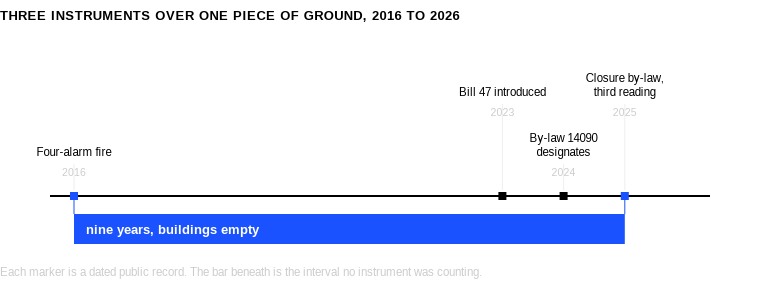
The interval, counted.
The arithmetic is elementary and it is the part worth holding.
| Figure | What it is |
|---|---|
| 771 | days from the statute’s introduction to the closure by-law’s third reading 10 |
| 540 | days from the designation by-law to that third reading 11 |
| 231 | days from the statute’s introduction to the designation by-law 12 |
| 9 | calendar years from the fire to the closure decision 13 |
Two years and one month separate the statute from the vote. A year and a half separates the designation from it. These are not narrow margins. They are long enough for a document to be read, cited and answered, in either direction.
And the direction that matters is the one nobody was required to travel. A district weighing a site has no obligation to read a municipal designation by-law, because no instrument imposes one. A city designating an area has no obligation to read a district’s closure file, for the same reason. The absence is symmetrical, which is how I know it is structural.
Nothing above says the closure decision was wrong, and nothing above says it should have gone the other way. The Board took the decision it was elected to take, through the process Policy 14 sets out, with a published report, a public engagement period and a recorded vote2. I have no view on the merits and this column will not acquire one.
Nor does anything above claim that the designation changes the enrolment arithmetic. Whether housing approved under a transit-oriented designation produces children, at what yield, and in which school year, is an open question this series carries unclosed. The point is narrower and it survives either answer: two instruments landed on the ground inside the file’s own interval, and the file records neither.
Asymmetry of duration.
The first cost is asymmetry of duration. A designation by-law is close to permanent in practice, because the statute behind it sets a floor a municipality is required to permit. A closure decision resolves a building. The shorter instrument was taken with no reference to the longer one, and the longer one will still be operating on that ground when everyone involved in the December vote has moved on.
The second cost falls on the next file rather than this one. Every rapid transit station in the region now carries the same 800 metre radius, and every public site inside one is governed by a density floor that was set elsewhere. A body that reads only its own enrolment curve on such a site is reading the one input the statute has already committed to move. That is true whether or not the movement is large.
The third cost is the ordinary one this column keeps arriving at. A resident at that corner is governed by all three instruments at once. No document published by any of the three bodies shows the corner whole, so the assembly work falls on whoever wants to understand it, which in practice means it falls on nobody.
One field on the closure report template.
Where a site sits inside a designated transit-oriented area, the report carries the designation by-law number, the date of designation, and the tier that applies to the parcel14. Three items, one line, drawn from a by-law the municipality has already published.
That line settles nothing on its own, and it is meant to settle nothing. A board reading it takes exactly the decision it was going to take. What changes is that the density floor sitting under the ground is visible at the moment of the vote rather than reconstructible two years afterwards by someone reading three files in parallel.
The same field would work in the other direction, which is the half people forget. A municipal designation report carrying the enrolling status of every public school site inside the area would tell a council what its own floor is being placed over.
So here is my conclusion. A statute and a by-law changed what one piece of ground is required to hold, and no instrument required anyone to read that against the file already open on it. The law moved. The file did not. Nobody failed a duty, because no duty existed.
Printing the by-law number changes no vote. It changes what a person can see while the vote is still ahead of them. If you sit on a body about to decide something on a piece of public ground, ask which other statute has landed on that ground since the file opened, and ask for the answer with a date on it.
Sources
-
Vancouver School Board, Proposed Closure of Sir Guy Carleton Elementary School, report of the Superintendent, Special Board Meeting Agenda (Revised), 17 December 2025. The 2016 fire and the end of enrolment in the same year, the 2023 catchment adjustment, and the holding cost stated at page 3 as roughly $65,000 per year or $650,000 to date. ↩ ↩2 ↩3
-
Vancouver School Board, minutes of the special board meetings of 17 and 18 December 2025, carried in the board agenda package of 28 January 2026. First and second readings on 17 December 2025, third reading on 18 December 2025, and the vote of five to three. ↩ ↩2
-
Province of British Columbia, Legislation introduced to deliver more homes near transit hubs, news release, 8 November 2023. The introduction date of the transit-oriented development legislation, the 800 metre definition, and the height bands of twenty storeys, twelve storeys and eight storeys by distance from a SkyTrain station. ↩
-
Union of British Columbia Municipalities, Province introduces transit-oriented development legislation, 15 November 2023. The definition of a transit-oriented development area as land within 800 metres of a rapid transit station, and the quoted restriction on requiring off-street residential parking spaces. ↩ ↩2
-
Province of British Columbia, Provincial Policy Manual: Transit-Oriented Areas, version 4.0, 19 February 2026. The tier table for a SkyTrain station in Metro Vancouver, at up to twenty storeys and 5.0 floor space ratio within 200 metres, up to twelve and 4.0 between 200 and 400 metres, and up to eight and 3.0 between 400 and 800 metres, and the statement that from 30 June 2024 the parking legislation restricts a municipality’s ability to require residential off-street parking in a designated area. ↩ ↩2
-
City of Vancouver, Transit-Oriented Areas Designation By-law, By-law No. 14090, enacted 26 June 2024, effective 30 June 2024. The title, enactment and effective dates, the designation of areas identified in the Schedule A maps, and the rule that where areas overlap the tier with the highest permissible height and density applies. The prescribed figures are minimums on what a municipality must allow, not minimums on what must be built. The by-law is not itself a rezoning: the City states that owners must still apply to rezone to build above what current zoning allows, so the designation changes what the city must be prepared to permit rather than what stands on the ground. City of Vancouver, 26 June 2024: https://vancouver.ca/news-calendar/city-passes-housing-transit-friendly-action-june-2024.aspx ↩ ↩2 ↩3
-
City of Vancouver, City passes housing and transit friendly action, 26 June 2024. The designation of twenty-nine transit-oriented areas and the elimination of minimum parking requirements citywide for all land uses on the same day. ↩
-
Vancouver School Board, Consideration of Closure of Sir Guy Carleton Elementary School, Facilities Planning Committee agenda, 7 June 2023. The repair estimate of $8 million to $10 million, the absence of any annual holding-cost figure in the 2023 report, and the statement that planned enrolment for September 2016 stood at 308 students. ↩ ↩2
-
VTCo, The price that never had to be argued, The Split Record, 12 October 2026. The 874-day separation between the repair estimate of 2023 and the holding-cost figure of the 2025 cycle, and the different ways each figure entered the record. ↩
-
Days from the statute’s introduction to the closure by-law’s third reading: 771.
8 November 2023 to 18 December 2025 = 771 daysElapsed calendar days between the provincial news release announcing the introduction of the legislation and the third reading of the closure by-law. It measures separation in time and carries no claim that either body was aware of the other. ↩ -
Days from the designation by-law to that third reading: 540.
26 June 2024 to 18 December 2025 = 540 daysCounted from enactment of By-law 14090 rather than from its effective date of 30 June 2024, which would shorten the interval by four days. ↩ -
Days from the statute’s introduction to the designation by-law: 231.
8 November 2023 to 26 June 2024 = 231 daysThe interval in which the province’s framework became a municipal instrument. It is the one interval in this piece where two bodies were demonstrably reading each other. ↩ -
Calendar years from the fire to the closure decision: nine.
2025 − 2016 = 9Counted in whole years because the public record read for this piece gives the fire as August 2016 without a day. The exact figure moves by a few months with the day. ↩ -
Open gate: the designated area and tier have not been read. City of Vancouver, Schedule A maps to By-law 14090, identifying the designated transit-oriented area containing 3250 Kingsway and the tier applying to the parcel [no public URL located]. The site is confirmed to sit inside a designated transit-oriented area. Which of the twenty-nine areas contains it, and which distance tier applies to the parcel, requires reading the by-law schedules directly. Until that is done this piece states no minimum height for the parcel. ↩