Primary Sources The documents themselves, cited. Published Wednesdays.
The grant follows the building for twenty years
Massachusetts funds school construction through a statutory formula capped at 80 per cent.
British Columbia sets out what a board may do with a school it no longer needs. Massachusetts wrote a different sentence, and put it in the chapter that pays for the building, where it runs for twenty years after the money lands.
The authority, and the statute that created it.
Chapter 70B of the General Laws of Massachusetts runs to more than twenty numbered sections and governs state assistance for school buildings1.
Section 1A creates the body that administers it: “There is hereby created a body politic and corporate and a public instrumentality to be known as the Massachusetts School Building Authority”, described in the same section as “an independent public authority not subject to the supervision and control of any other executive office, department, commission, board, bureau, agency or political subdivision”2.
The authority’s own account of itself matches: it describes itself as “a quasi-independent government authority created to reform the process of funding capital improvement projects in the Commonwealth’s public schools”, states that “the Legislature created the MSBA in 2004”, and names its money: “a dedicated revenue stream of one penny of the state’s 6.25-percent sales tax”3.
So the chapter establishes a standing body, gives it a defined revenue source, and then writes the rules it applies into the same statute. Four of those rules are read below: the formula, the queue, the proceeds rule, and what each one leaves to discretion.
The grant is a formula, and the formula is in the statute.
Section 10 sets out how a facilities grant percentage is built. It states a base: “Base Percentage (A) = 31 percentage points”. To that base it adds a community income factor, a community property wealth factor and a community poverty factor, and then an incentive percentage4.
Three caps sit on top. “No individual category of incentive points shall exceed 6 additional points”. “No district shall receive more than 18 incentive percentage points”. And over everything, “no grant percentage shall be greater than 80 per cent”4.
| Figure | What it is |
|---|---|
| 31 | percentage points. The statutory base rate. |
| 80 | per cent. The statutory ceiling on any grant. |
| 18 | the incentive points ceiling for any district. |
| 6 | the ceiling on any single category of incentive points. |
Those four numbers fix the shape of the whole formula. The distance between the base and the ceiling is 49 percentage points5. Of that distance, at most 18 can come from incentives, which leaves at most 31 points to be carried by the three community factors together6.
Every one of those quantities is in the statute rather than in a guidance document, which means the range a district can occupy is fixed by the legislature and the position it occupies inside that range is set by published community characteristics.
The queue is ranked in the statute as well.
Section 8 states an order of priorities the authority applies to school projects. The categories are ranked, and the ranking is legislative rather than administrative7.
| Rank | Category, as the section groups them |
|---|---|
| 1 | Buildings structurally unsound or seriously jeopardising health and safety |
| 2 | Existing severe overcrowding |
| 3 | Projects needed to prevent loss of accreditation |
| 4 | Severe overcrowding anticipated from rising enrolment |
| 5 | Heating system replacement, renovation or modernisation for conservation |
| 6 | Short term enrolment growth |
| 7 | Replacement of obsolete buildings to provide a full range of programmes |
| 8 | Transition from court-ordered and authority-approved racial balance districts |
The first category is quoted in the section as covering buildings “structurally unsound or otherwise in a condition seriously jeopardizing the health and safety” of occupants. The third covers projects required “to prevent loss of accreditation”7.
A ranking of this kind does two things at once. It tells a district where an application will sit before the application is written, and it fixes the grounds on which the authority may move one project ahead of another.
What happens when an assisted building is sold or leased.
Section 15 is the provision that reaches furthest into the years after a building opens, and it is the one this series has been looking for in every jurisdiction it has read.
The trigger is stated at the opening: “In the event that an eligible applicant sells or leases an assisted structure or facility”. The section also reaches removal of an assisted structure from use as a schoolhouse8.
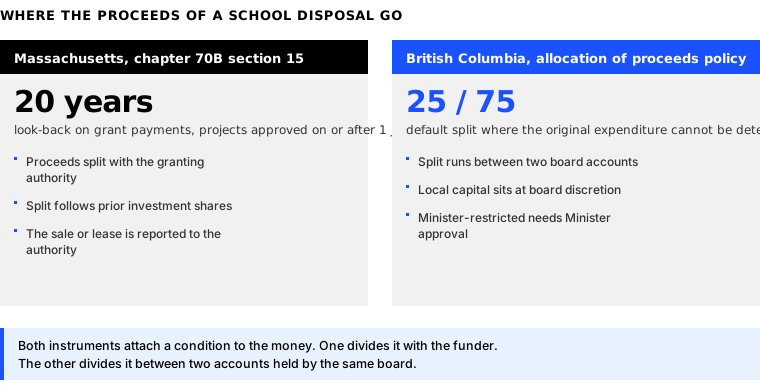
The consequence is a division: “the proceeds from the sale or lease shall be divided between the authority and the general funds of the applicable eligible applicant in proportion to the commonwealth’s and authority’s prior investments”8.
The reach is dated: for a project approved on or after 1 July 2004, the section applies where the applicant “has received at least 1 grant payment in the preceding 20 years”. For a project approved before that date, “the authority’s share of the proceeds shall reduce the balance of outstanding grant payments that would otherwise be payable except for this section and shall not exceed that amount”8.
And the section carries a reporting duty. Applicants “shall report the sale, lease or removal to the authority in the form and manner and within the time prescribed by the authority”8.
So the statute that pays for the building states in the same chapter what happens to the money if the building is later sold or leased, sets the split by prior investment, and holds the rule open for twenty years after the last grant payment.
British Columbia has a proceeds rule too.
The provincial arrangement is assembled from two instruments rather than one.
Ministerial Order M193/08, effective 3 September 2008, sets the threshold: a board must not dispose by sale and transfer in fee simple, or by a lease of ten years or more, unless the disposal is to another board or an independent school for educational purposes or the Minister approves it. Section 6 requires boards to develop, implement and publish their own disposal policies. Section 9 requires notification of the Minister on disposition and addresses the allocation of proceeds9.
The allocation itself sits in a policy titled Allocation of Proceeds from the Disposition of Capital Assets, issued 18 February 2004 and last revised 18 December 2025. The page names its authority as sections 100(3) and 100.1 of the School Act together with section 6 of the Disposal of Land or Improvements Order10.
Its rule is stated directly: “The proceeds received by a board of education from the disposition of a capital asset must be allocated between local capital funds and minister-restricted capital funds, based on the original expenditure for the capital asset”. Where the original contributions cannot be determined, the policy sets a default of “25 percent as local capital funds and 75 percent as minister-restricted capital funds”10.
The two accounts differ in who may spend them. “A board’s local capital funds may only be used by the board for capital projects at its own discretion. A board’s minister-restricted capital funds may only be used by the board for capital projects with the approval of the minister”10.
On the default, three of every four dollars of an undetermined allocation require ministerial approval before they can be spent11. The policy has been in force for twenty-one years and ten months from issue to its most recent revision12.
The two proceeds rules, side by side.
| Element | Massachusetts | British Columbia |
|---|---|---|
| Where the rule lives | The funding statute, chapter 70B | A Ministerial Order and a Ministry policy |
| What triggers it | Sale, lease, or removal from use as a schoolhouse | Disposition of a capital asset |
| Basis of the split | Prior investments of the commonwealth and the authority | Original expenditure for the capital asset |
| Default where the basis is unclear | Not stated in the section read | 25 per cent local, 75 per cent minister-restricted |
| Who holds the other share | The authority that made the grant | The same board, in a restricted account |
| Time limit written in | At least one grant payment in the preceding 20 years | Not stated in the policy read |
| Reporting duty | Report to the authority, in the form it prescribes | Notification of the Minister on disposition |
What the comparison establishes.
Both jurisdictions have decided that money from a school disposal carries a condition. Neither treats it as ordinary revenue, and on that point the two systems agree.
They differ on the counterparty. In Massachusetts the split is external: a share returns to the body that paid for the building, and the size of that share is set by what each side put in. In British Columbia the split is internal: the whole sum stays with the board, and the division decides which portion the board may spend at its own discretion and which portion requires the Minister.
They differ on where the rule sits. Massachusetts puts it in the chapter that authorises the grant, which means a district reading the funding rules encounters the disposal consequence in the same document. British Columbia puts the threshold in a Ministerial Order, the allocation in a Ministry policy, and the procedure in a board policy written under section 6 of the order.
And they differ on how long the rule reaches. The Massachusetts section carries an explicit twenty-year window tied to grant payments. The provincial policy read here states a basis, the original expenditure, and no window.
What the comparison leaves open.
No Massachusetts project file was read for this piece. The statute states the rule and the count of occasions on which section 15 has operated stays unread, so nothing here describes practice in that state.
No allocation for any particular British Columbia disposition was read. The policy states the rule and the split applied to any single sale is a district record that this piece has not opened.
And the two systems fund schools on different bases, so the comparison runs between instruments rather than between outcomes. What each text requires is on the record above. What each produces is a separate count that neither document supplies.
What both instruments have in common.
Each of the two rules exists because a building bought with public money can later become money again, and each jurisdiction decided in advance where that money goes. The instruments differ in reach, counterparty and location, and both settle the question before the sale rather than during it.
A record can carry that much. It can put the funding rule, the disposal threshold and the proceeds rule on one page, with the date each was last revised, so a reader holds the whole chain at once.
Every figure above carries its section and its source. The statutes are public in both jurisdictions and the arithmetic is shown at the end.
Sources
-
General Laws of Massachusetts, Title XII, chapter 70B, section index. That the chapter runs to more than twenty numbered sections, and the titles of the sections relied on here: section 1A on the authority, section 8 on the order of priorities, section 10 on the grant formula, and section 15 on sale or lease of assisted school buildings. ↩
-
General Laws of Massachusetts, chapter 70B, section 1A. The creation of the Massachusetts School Building Authority as a body politic and corporate and a public instrumentality, and its description as an independent public authority not subject to the supervision and control of any other executive office, department, commission, board, bureau, agency or political subdivision. ↩
-
Massachusetts School Building Authority, About the MSBA. The authority’s description of itself as a quasi-independent government authority created to reform the process of funding capital improvement projects in the Commonwealth’s public schools, its creation by the Legislature in 2004, and its dedicated revenue stream of one penny of the state sales tax of 6.25 per cent. ↩
-
General Laws of Massachusetts, chapter 70B, section 10. The base percentage of 31 percentage points, the community income, community property wealth and community poverty factors, the incentive percentage, the cap of 6 points on any individual category of incentive points, the cap of 18 incentive percentage points for any district, and the ceiling that no grant percentage shall be greater than 80 per cent. ↩ ↩2
-
Distance between the statutory base rate and the statutory ceiling: 49 percentage points.
80 − 31 = 49The ceiling in section 10 less the base percentage in the same section. It measures the width of the range the formula can move a district across, and says nothing about where any district actually lands. ↩ -
Points available to the three community factors together: at most 31.
80 − 31 − 18 = 31The ceiling less the base rate less the maximum incentive points any district may receive. It is an upper bound implied by the three caps in section 10, not a figure the section prints. ↩ -
General Laws of Massachusetts, chapter 70B, section 8. The ranked order of priorities the authority applies to school projects, the eight categories in the order the section groups them, and the wording of the first and third categories. ↩ ↩2
-
General Laws of Massachusetts, chapter 70B, section 15. The trigger on sale, lease or removal from use as a schoolhouse; the division of proceeds between the authority and the general funds of the eligible applicant in proportion to prior investments; the twenty-year look-back for projects approved on or after 1 July 2004; the treatment of projects approved before that date as a reduction in outstanding grant payments; and the duty to report the sale, lease or removal to the authority. ↩ ↩2 ↩3 ↩4
-
Province of British Columbia, Ministerial Order M193/08, Disposal of Land or Improvements Order, effective 3 September 2008. The ten-year threshold and the Minister approval requirement in section 3, the requirement in section 6 that boards develop, implement and publish disposal policies consistent with the order, and the notification and proceeds allocation provisions in section 9. ↩
-
Province of British Columbia, Allocation of Proceeds from the Disposition of Capital Assets, issued 18 February 2004, last revised 18 December 2025. The requirement that proceeds be allocated between local capital funds and minister-restricted capital funds based on the original expenditure for the capital asset, the default of 25 per cent local and 75 per cent minister-restricted where original contributions cannot be determined, the permitted uses of each account, the stated statutory authority in sections 100(3) and 100.1 of the School Act and section 6 of the Disposal of Land or Improvements Order, and the issue and revision dates. ↩ ↩2 ↩3
-
Default ratio of minister-restricted to local capital: three to one.
75 ÷ 25 = 3Applies only where the original contributions cannot be determined. Where they can be determined, the policy sets the split by original expenditure instead, so this ratio describes the fallback and not the general case. ↩ -
Time between the issue of the allocation policy and its most recent revision: twenty-one years and ten months.
18 February 2004 to 18 December 2025 = 21 years and 10 monthsBoth dates are printed on the policy page. The span measures the interval between issue and latest revision and establishes nothing about revisions in between. ↩