The Split Record A personal column by Vik Khanna, published Mondays.
Ninety per cent of the price came from a school sale
Richmond bought back a school site in 2025 for $60 million. The province put in $6 million. The district put in $54 million, from the proceeds of a school it had sold.
Richmond bought back a school site in June 2025 for $60 million. The province contributed $6 million. The district contributed $54 million, from the proceeds of a school it had already sold. That is the local capital mechanism running as designed, and it is the cleanest published instance of it. This piece reads the transaction against the policy that governs where school-land money goes.
Most arguments about selling school land are arguments about a number nobody has looked up. The number is what the money can lawfully do once it arrives, and it is published, and I had read a great deal of commentary on disposal before I read it.
One British Columbia transaction shows the whole mechanism working end to end, on the district’s own announcement, with both funders named and both amounts printed. It is the cleanest instance on the published record, and the part most often reported the wrong way round is the part that carries the finding.
The transaction, and who paid for it.
On 23 June 2025 the Richmond Board of Education announced a new kindergarten to grade seven school in City Centre. The district had purchased the site and building at 8671 Odlin Crescent, a school first opened in 1962, with an opening target of as early as September 20261.
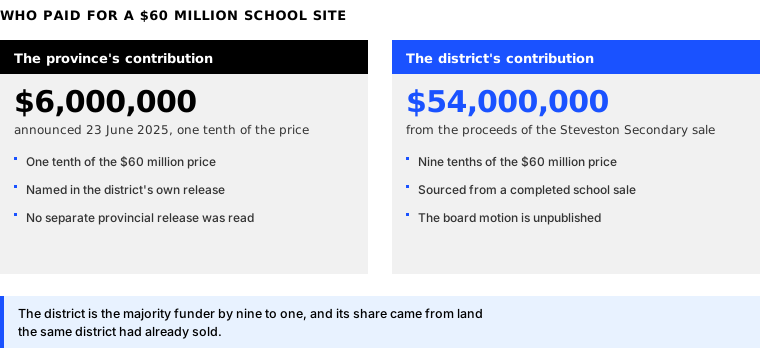
The price was $60 million. The Province contributed $6 million. The Richmond School District contributed the remainder, $54 million2, and the announcement names its source: the proceeds of the Steveston Secondary sale1.
The school was named City Centre Elementary School, approved and announced on 23 April 20263.
| Element | Figure | Record and date |
|---|---|---|
| Purchase price | $60 million | District announcement, 23 June 2025 |
| Province’s contribution | $6 million | District announcement, 23 June 2025 |
| District’s contribution | $54 million | VTCo calculation from the announcement: $60m less the Province’s $6m2 |
| Source of the district’s share | Proceeds of the Steveston Secondary sale | District announcement, 23 June 2025 |
| Renovation | $5.5 million local capital project | District project record, 2025 to 2026 |
| Site address | 8671 Odlin Crescent, Richmond | District announcement, 23 June 2025 |
What the split gives when it is divided out.
The district funded 90 per cent of the purchase and the province funded the remaining tenth4. Put as a ratio, the district contributed nine dollars for every one the province contributed5.
That correction matters more than it looks. A reacquisition of this size reads, in summary, as a province stepping in to buy back a school. On the district’s own announcement the province is the minority contributor and the school district is the majority funder, and the majority funding came from land the district had already let go.
Add the renovation and the local share grows. The renovation is a $5.5 million local capital project, which brings the district’s outlay on this file to $59.5 million against the province’s $6 million, a ratio of about ten to one67.
What the policy does with the proceeds of a disposal.
The province publishes the rule that governs where money from a school-land disposition goes. The policy is titled Allocation of Proceeds from the Disposition of Capital Assets. It was issued on 18 February 2004 and last revised on 18 December 2025, and it names its authority as sections 100(3) and 100.1 of the School Act together with section 6 of the Disposal of Land or Improvements Order8.
Its central sentence: “The proceeds received by a board of education from the disposition of a capital asset must be allocated between local capital funds and minister-restricted capital funds, based on the original expenditure for the capital asset”8.
The two accounts differ in who may spend them. “A board’s local capital funds may only be used by the board for capital projects at its own discretion. A board’s minister-restricted capital funds may only be used by the board for capital projects with the approval of the minister”8.
And where the original contributions cannot be determined, the policy sets a default: 25 per cent local capital funds, 75 per cent minister-restricted8.
So the money from a school sale is capital money on both sides of the line, and neither side can become an operating budget. What the allocation settles is who has to be asked before it is spent.
As an illustration of scale rather than a description of this transaction, the default applied to a $54 million allocation would put $13.5 million at board discretion and leave $40.5 million requiring the Minister’s approval9. Whether any part of the Steveston proceeds fell to that default stays open on the records read.
The case the district published for the purchase.
The announcement carries the enrolment argument in one sentence: “Student enrolment has increased by 42 percent over the past four years, and schools originally built for 1,641 students are now serving more than 2,000 students”1.
Taken at the figures given, the area was carrying at least 359 students above what its schools were built for, about 122 per cent of the built figure10.
The rest of the file is ordinary project administration and it is published: a building permit issued on 27 November, Unitech Construction as contractor, completion expected in August 2026 and reported on budget, and a catchment approved on 21 January 20267.
The instrument that let the site go in 1990.
The site left public education in 1990, and how it left matters to any reading of what it cost to get back.
The available reporting describes a property exchange with a counterparty named Rec Holdings, with Land Title documents dated 22 August 1990. The figure of $5.67 million attached to that transaction is a valuation inside the exchange rather than a cash price, and what the district received was three properties, which became Anderson elementary and the MacNeill secondary site11.
That account is single-sourced to a local news outlet, so it is carried here as secondary reporting and flagged as such. Any sentence describing the site as sold for $5.67 million in 1990 is wrong on this record, and the arithmetic that compares $5.67 million with $60 million compares a valuation inside a swap with a cash purchase price thirty-five years later. The two figures are not the same kind of quantity, and no page in either file says so.
What the record does not carry.
One document is missing from the public side of this transaction, and it is the one that would ordinarily anchor everything above. No published record read carries the board motion approving the $60 million purchase. Every 2025 public minute set was checked and no motion appears; the nearest board-record acknowledgement is 24 June 2025, where the Secretary Treasurer refers to the recent acquisition of a new City Centre school while presenting the amended five-year capital plan12.
The purchase was authorised in closed session, which is permitted, and the closed session is why the announcement of 23 June 2025 is doing the work a motion would normally do. Until the motion is read, the terms, the conditions and the authority under which the $54 million was committed stay open, and the gate is printed below13.
The allocation of the Steveston proceeds between local capital and minister-restricted capital is a district record as well, and it stays unread here.
The scope of this reading.
Nothing here argues that Richmond should or should not have bought the site, that the price was high or low, or that any board acted improperly. Districts buy and sell land for documented reasons and the reasons here are published. Nothing here characterises the province’s contribution as adequate or otherwise, because the record read carries the amount and not the reasoning. It reads one transaction in one district against one provincial policy, and the ninety per cent figure describes this purchase rather than any general pattern.
The cost the arithmetic makes visible.
The first cost is the one the arithmetic makes visible. A district that funds nine tenths of a reacquisition from the proceeds of a previous sale has converted one site into another, and the estate is smaller by one site at the end of it. That may be exactly the right trade in a growing city centre. What no page carries is the trade itself, stated as a trade, at the moment either decision is taken.
The second cost falls on every argument about disposal that has ever been had in a public meeting. Because the permitted uses of disposal proceeds are published in one policy and the transaction is published in another document, a participant can argue in good faith that a sale would fund almost anything, and a second participant can argue in equally good faith that it would fund almost nothing. Both are arguing about a rule that has been in force since 2004 and was last revised in December 2025.
The third cost is to the reader of a summary. The most easily reported sentence about this file is that a province funded a $60 million school buy-back. The district’s own release says otherwise, in the same sentence, and the correction never travels as far as the error.
Three sentences on the face of every disposal proposal.
Three sentences on the face of every disposal proposal and every acquisition report. Which account the proceeds enter. What that account may lawfully fund. What contribution the province is expected to make toward the projects those proceeds are meant to enable.
All three sentences already exist in published instruments. Nothing new has to be written, and no rule has to change. What has to change is where the sentences sit, so that everyone arguing about a school site is arguing about the same transaction.
Printing the allocation rule beside the proposal leaves every judgment where it sits now, with the trustees elected to make it. What it settles is what the money can do, before anyone argues about what it should do.
My view is that the mechanism worked and that is the point. Ninety per cent of the price came from selling a school, which is what the policy contemplates. A district that wants a school back buys it with the proceeds of a school it gave up. Whether that is a funding system or a treadmill is a judgement I will make: on this record it is a treadmill.
If you sit on a board considering a disposal, ask for the allocation split on the last one, in dollars, by account. On the policy read here the answer exists in the district’s own books.
Further records read for this piece are set out in Sources.14
Sources
-
Richmond School District, Richmond Board of Education announces new K-7 school in City Centre, 23 June 2025. The purchase price of $60 million, the provincial contribution of $6 million, the district contribution of $54 million and its source in the proceeds of the Steveston Secondary sale, the enrolment statement quoted, the site address, and the target opening of as early as September 2026. ↩ ↩2 ↩3
-
Richmond School District, City Centre Elementary School name approved, 23 April 2026. The approval and announcement of the school’s name on 23 April 2026, and the identification of the site as the school at 8671 Odlin Crescent. ↩
-
Ratio of district funding to provincial funding on the purchase: nine to one.
54 ÷ 6 = 9A ratio of the two announced contributions. It establishes who funded what share of this purchase and nothing about how any other project has been funded. ↩ -
District outlay including the renovation: $59.5 million, about ten to one against the provincial contribution.
$54 million + $5.5 million = $59.5 million; 59.5 ÷ 6 = 9.9Adds the announced renovation budget to the announced purchase contribution. The renovation is a separate project with its own approval, so this figure is a total outlay on one file rather than a single transaction. ↩ -
Richmond School District, City Centre Elementary project record: the $5.5 million local capital renovation, the building permit of 27 November, the contractor Unitech Construction, the expected completion in August 2026 and the catchment approval of 21 January 2026 [no public URL located]. The renovation budget and its treatment as a local capital project, the permit, the contractor, the completion expectation and budget status, and the catchment approval date. ↩ ↩2
-
Province of British Columbia, Allocation of Proceeds from the Disposition of Capital Assets, issued 18 February 2004, last revised 18 December 2025. The requirement that proceeds from a disposition be allocated between local capital funds and minister-restricted capital funds based on the original expenditure, the default of 25 per cent local and 75 per cent minister-restricted where original contributions cannot be determined, the permitted uses of each account, the stated statutory authority, and the issue and revision dates. ↩ ↩2 ↩3 ↩4
-
The policy default applied to $54 million: $13.5 million at discretion, $40.5 million requiring approval.
25 per cent × $54 million = $13.5 million; 75 per cent × $54 million = $40.5 millionAn illustration of the scale of the policy default rather than a description of this transaction. The default applies only where the original contributions to a capital asset cannot be determined, and the allocation of the Steveston proceeds stays unread here. ↩ -
Students above the figure the schools were built for: at least 359, or about 122 per cent.
2,000 − 1,641 = 359; 2,000 ÷ 1,641 = 1.219The announcement states more than 2,000 students against schools built for 1,641, so 359 is a floor rather than an exact count. The figures are the district’s own and no independent enrolment record was read. ↩ -
Richmond News, report on the Richmond School District’s reacquisition of a 1962 public school, secondary reporting. The 1990 property exchange with Rec Holdings, the Land Title documents dated 22 August 1990, the $5.67 million figure as a valuation inside the exchange rather than a cash price, and the three properties the district received, which became Anderson elementary and the MacNeill secondary site. This is a single secondary source and is treated as such. ↩
-
Richmond School District, board record of 24 June 2025, retrievable through the district’s board meetings page, Secretary Treasurer’s reference to the recent acquisition of a new City Centre school while presenting the amended 2026/27 Five-Year Capital Plan, assembled from the published agendas and minutes and retrievable through the district’s agendas and minutes search. The nearest acknowledgement of the purchase in the district’s own board record, and that no motion approving the purchase appears in the 2025 public minute sets checked. ↩
-
Checked, not published. Richmond Board of Education, the closed-session motion authorising the 2025 purchase of the City Centre site [no public URL located]. Looked for and absent from public. The purchase of the City Centre site at $60 million was announced on 23 June 2025 and later records refer to it as completed. The authorising motion, the price approval, and the allocation of the Steveston Secondary proceeds between local and minister-restricted capital appear in no open-session minute set. The decision was settled in closed session. ↩
-
Province of British Columbia, Ministerial Order M193/08, Disposal of Land or Improvements Order, effective 3 September 2008. The requirement in section 6 that boards develop, implement and publish disposal policies consistent with the order, and the ten-year threshold above which a disposal requires Minister approval. ↩